

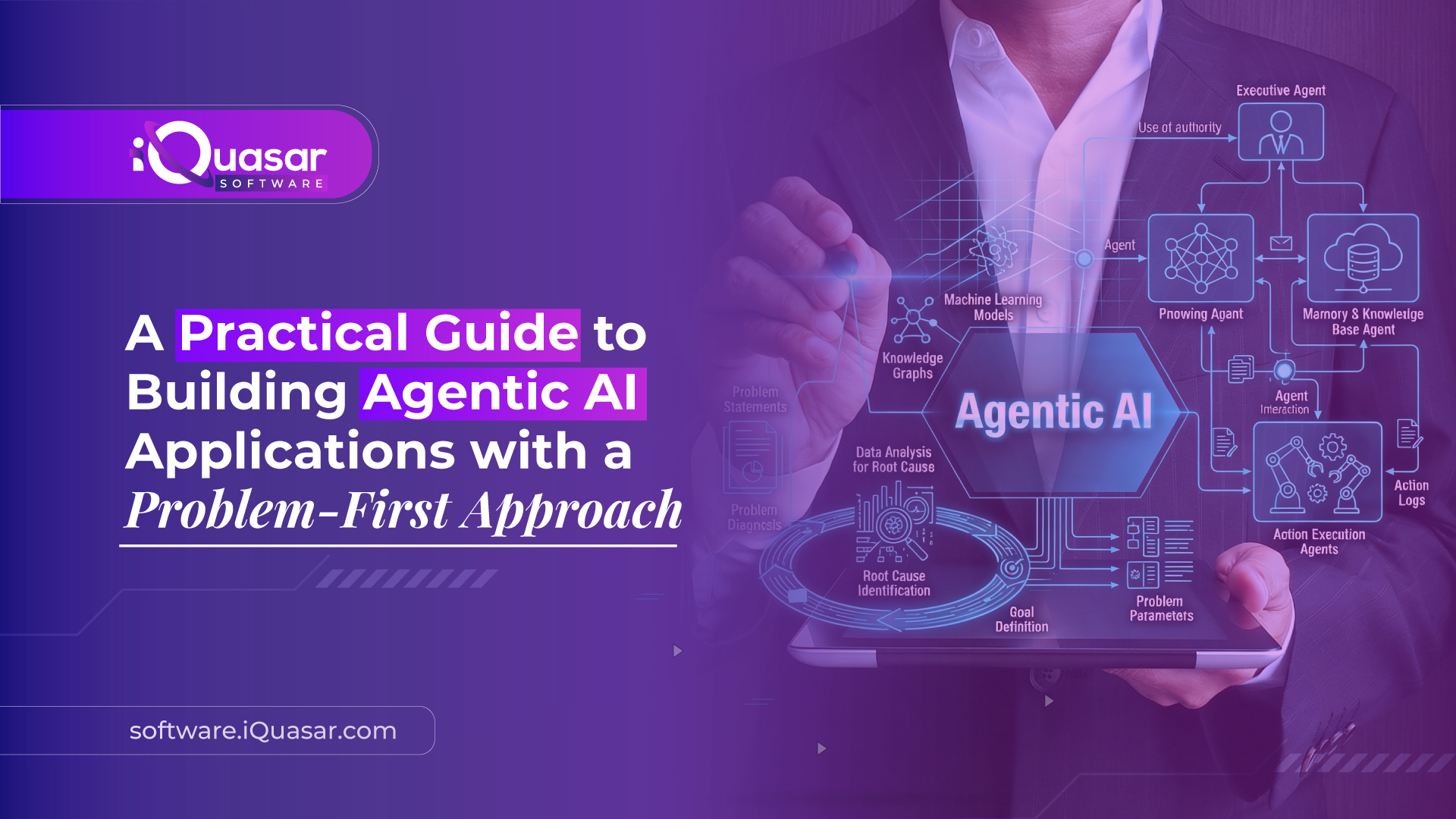
There is a distinct difference between a chatbot that talks and an agent that acts. Generative AI creates content. However, the true frontier of enterprise value lies in building Agentic AI applications with a problem-first approach. These systems reason, use tools, and execute workflows autonomously.
Many organizations fall into the “hammer looking for a nail” trap. They deploy agents that fail to solve actual business problems. To succeed, you must pivot to a Problem-First Strategy. Start with a specific friction point. Then, engineer the intelligence to bridge it.
1. Defining Your Autonomous AI Strategy
When initiating your plan for building Agentic AI applications with a problem-first approach, the first step is to disqualify the agent. If a simple script or a basic Zapier automation works, do not build an agent.
An “Agentic” solution is only required when the problem meets these three criteria:
-
Ambiguity: The path to the solution is not a straight line.
-
Tool Dependency: The AI must “do” things, like querying a database or updating a CRM.
-
Multi-step Iteration: The AI must evaluate its own work and pivot if it fails.
2. Mapping Logic for AI Agents
Document the manual process before writing code. What tools would a human expert use? What data points would they seek? Understanding the manual workflow is essential for any autonomous agent framework.
The Logic Rule: If you cannot draw the workflow on a whiteboard, you cannot build an agent to execute it.
3. Architecting Reasoning Systems and Toolsets
When building Agentic AI applications with a problem-first approach, structure your architecture around two pillars:
-
The Reasoning Loop: Decide how the agent thinks. For high-stakes tasks, use a Plan-and-Execute pattern. This creates a roadmap first. Avoid chaotic patterns that lead to hallucination loops in LLMs.
-
The Toolset Capability: Give the agent the smallest set of tools required. Never give an agent “Full Admin Access.” If the task is “Update Lead Status,” only provide that specific API endpoint.
4. Establishing Guardrails for Agentic Workflows
Building Agentic AI applications requires prioritizing safety and cost-efficiency.
-
Token Budgets: Set a limit on the agent’s “thoughts.” This prevents high API fees from simple logical loops.
-
Human-in-the-Loop (HITL): For critical actions, like sending invoices, requires human permission. This is a staple in responsible AI development.
5. Measuring Success and Enterprise ROI
Don’t just check if an answer “looks good.” Create a “Golden Dataset” of 20–50 specific problems and known solutions. Run your autonomous AI agent against this dataset after every update. This ensures you don’t fix one issue while breaking others.
Moving from Concept to Deployment
The gap between a “cool demo” and a production-ready agent is wide. Most companies fail because they start with technology. By flipping the script—starting with business friction—you ensure real ROI. At iQuasar Software, we specialize in this methodology. We don’t just build AI; we build autonomous solutions. We integrate them into your specific workflows. We help you move from “AI-curious” to “AI-driven.”
Ready to build an agent that actually works? Explore our Custom AI Agent Development Services and let’s solve your complex challenges together.