
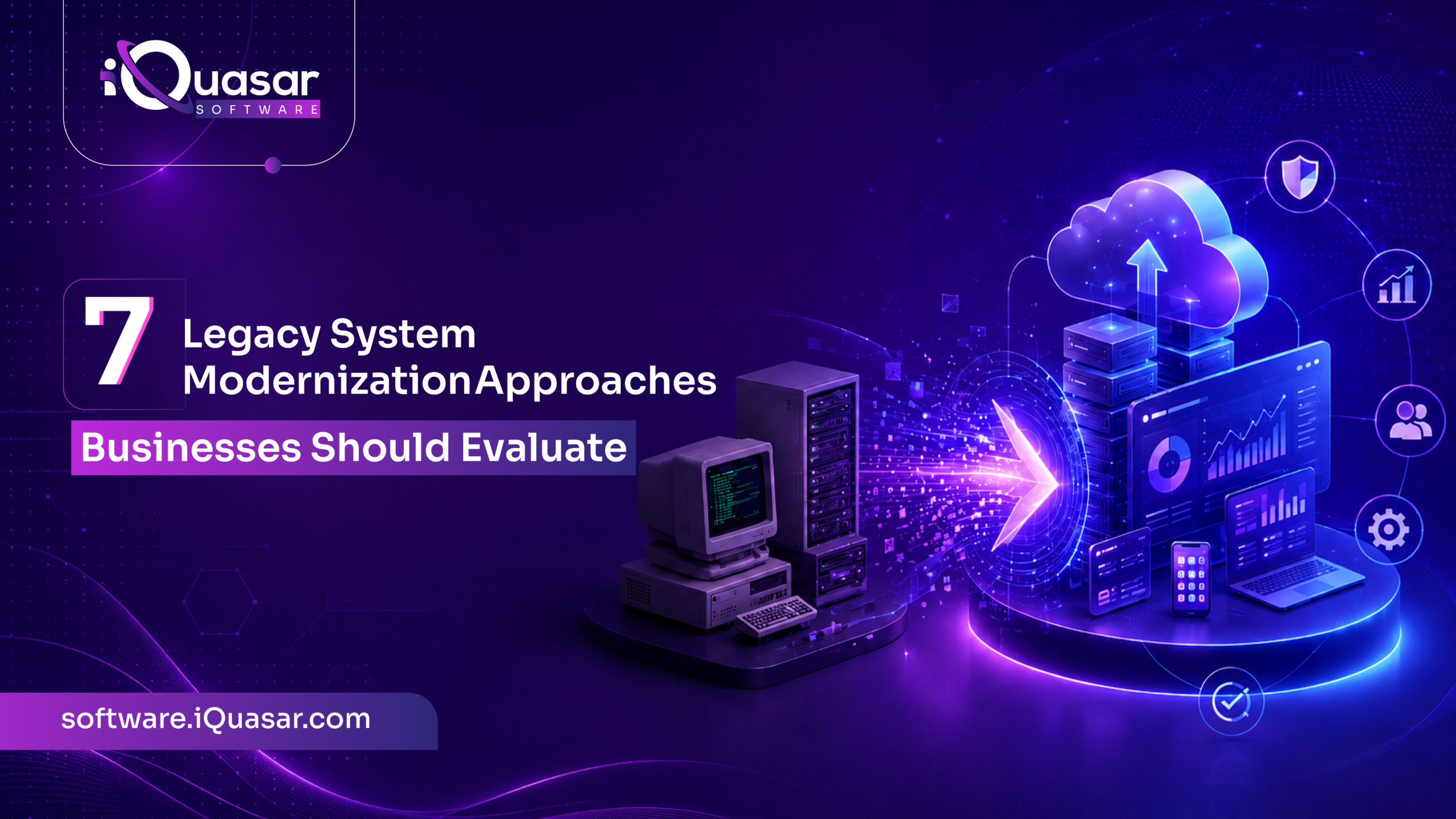
Legacy systems rarely fail all at once. They erode slowly — through rising maintenance costs, security gaps, integration friction, and a widening distance between what the business needs and what the technology can deliver. By the time modernization reaches the boardroom, it’s usually framed as a technical problem. It isn’t. It’s a capital allocation decision with direct consequences for security posture, customer experience, and competitive speed.
The good news: modernization is no longer a binary choice between “rip and replace” or “live with it.” There are several proven paths, each with a different risk, cost, and speed profile. The right one depends on your system’s condition, your regulatory environment, and how much disruption your business can tolerate. Below are seven approaches every executive should have on the table — along with where each one tends to make sense.
- Rehosting (“Lift and Shift”)
Rehosting moves an application from on-premise infrastructure to the cloud — AWS, Azure, or Google Cloud — with minimal changes to the underlying code. It’s the fastest way to exit aging data centers, reduce capital expenditure, and gain elastic scalability and built-in disaster recovery.
Best for: Systems that are functionally sound but constrained by outdated, expensive infrastructure. It’s often the first step in a longer modernization roadmap, not the final destination.
- Re-platforming
Re-platforming goes a step further than rehosting: the core functionality is migrated to a modern platform with targeted upgrades to improve scalability, security, or performance — without a full rebuild. Think of it as renovating a structurally sound building rather than replacing the foundation.
Best for: Systems with a solid core architecture but an outdated technology stack that’s becoming difficult to support or hire for.
- Refactoring
Refactoring incrementally restructures and cleans up the existing codebase — improving maintainability, performance, and security — while preserving the system’s external behavior. It’s a lower-risk way to pay down technical debt without disrupting operations, especially when paired with modern development practices like CI/CD and automated code quality checks.
Best for: Codebases that are reasonably well-structured but have accumulated years of shortcuts, duplication, or brittle dependencies.
- Encapsulation
Encapsulation wraps a legacy system in a modern API layer, allowing it to interact with newer applications and cloud services without touching the underlying code. Middleware solutions extend this further, letting legacy cores communicate cleanly with modern systems rather than forcing an all-or-nothing migration.
Best for: Mission-critical systems that still work but are too risky or expensive to rebuild outright. It buys time while shifting new development toward modern architecture — routing new functionality through cloud-native services while the legacy core continues handling stable, low-change processes.
- Rearchitecting to Microservices
Breaking a monolithic application into smaller, independently deployable services changes how a business ships software. Smaller codebases are easier to manage, faults in one service don’t take down the whole system, and teams can update components independently instead of coordinating massive, risky releases.
Best for: Organizations where release velocity and fault isolation are becoming competitive differentiators — and where the monolith is now the bottleneck to shipping faster.
- Rebuilding and Replacing (Including Mainframe Modernization)
Sometimes the legacy system — or the platform it runs on — has reached the end of its useful life. Rebuilding means redesigning and rewriting the application using current architecture and languages. For organizations still running mainframe workloads, this often means migrating to flexible, cost-effective cloud or server-based alternatives that reduce operational cost and improve maintainability. Low-code and no-code platforms can also accelerate parts of this work, reducing dependency on traditional development cycles and putting more capability directly in the hands of business users.
Best for: Systems where the cost of continued maintenance, compliance risk, or talent scarcity outweighs the cost of starting fresh.
- Data Modernization and AI-Readiness
Modernizing the application layer without modernizing the data underneath it is an incomplete strategy. Legacy data — often trapped in proprietary formats, siloed databases, or cryptic schemas that no analytics tool can interpret — blocks the single source of truth that AI, machine learning, and real-time analytics depend on. Migrating legacy data warehouses to modern cloud-based data platforms, and streaming legacy updates into a central lakehouse, ensures your organization is training models and making decisions on current reality rather than yesterday’s batch reports.
Best for: Any organization whose modernization roadmap includes AI or advanced analytics — which, in 2026, is nearly every organization.
Choosing the Right Legacy System Modernization Approaches
No single approach is universally correct, and most enterprises end up blending several — encapsulating a stable core while rearchitecting the components that need to move fast or rehosting first and refactoring second. The right sequence depends on:
- Risk tolerance: Can the business absorb a “big bang” cutover, or does it need an incremental, reversible path?
- Regulatory exposure: Are compliance and data governance requirements (e.g., NIST-aligned security frameworks) dictating the pace and order of changes?
- Talent and cost realities: Is the current system becoming unsupportable simply because the skills to maintain it are disappearing?
- AI and analytics ambitions: Is the modernization effort setting up the business for the next five years, or just patching the last five?
The Executive Takeaway
Legacy modernization isn’t an IT initiative that happens to have business implications — it’s a business strategy that happens to run through IT. Approached with a phased roadmap, disciplined governance, and the right architectural choices, modernization shifts your spend from keeping the lights on to building competitive advantage: faster time-to-market, lower operating costs, and the data foundation required for AI-driven growth.
At iQuasar Software, we help executives evaluate these legacy system modernization approaches against their specific systems, industry, and risk profile — then execute with the cloud, API, DevOps, and AI expertise needed to turn a legacy anchor into a modern engine. If your 2026 roadmap includes legacy modernization, let’s talk about which path gets you there fastest with the least risk.
Schedule a Free Consultation