

Few technology decisions shape a company’s next decade as much as the choice of ERP. It touches finance, supply chain, procurement, reporting and compliance, and once it is in place, it is expensive and disruptive to change. So when leadership teams discuss Oracle NetSuite ERP vs. SAP S/4HANA, the honest answer to “which is better?” is the one executives like least: it depends on your size, complexity and growth path.
This article gives you a practical, business-level comparison so you can decide which platform fits, and what to plan for either way.
The short version
- NetSuite is a cloud-native ERP, built for speed to value, ease of change and fast-growing small and mid-sized organisations, including multi-entity and multi-country operations.
- SAP S/4HANA is a deeply configurable enterprise platform, built for large, complex, process-heavy organisations that need industry depth and tight control.
Neither is universally superior. Each is the right answer for a different kind of company.
At a glance
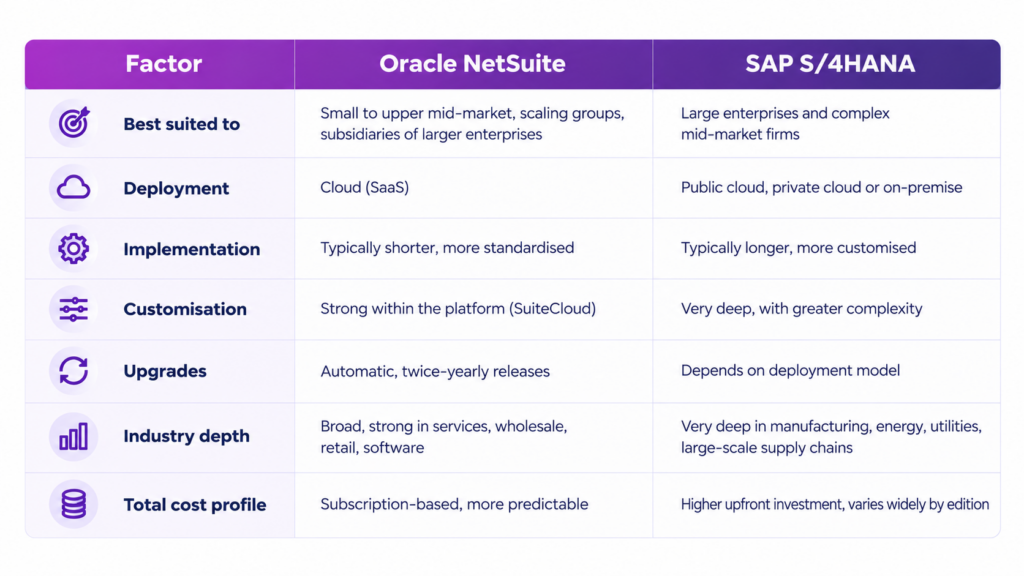
Treat this table as a starting point. Specific fit depends on your requirements, and both vendors offer multiple editions and licensing models.
1. Business size and complexity
The most useful question is not “which has more features?” but “how complex is our business, really?”
- NetSuite works well when you need a single system for finance, inventory, order management, CRM and reporting, without the overhead of a heavily customised landscape. It is commonly chosen by growing companies replacing spreadsheets or entry-level accounting software, and by subsidiaries that need a lighter-weight ERP than their parent company’s.
- S/4HANA tends to suit organisations with intricate, high-volume processes: multi-stage manufacturing, complex global supply chains, heavy regulatory obligations or very large transaction volumes. Its depth comes with a greater need for governance, design discipline and specialist skills.
2. Deployment and control
NetSuite is a true cloud service. You do not manage infrastructure, patching or upgrades, which reduces IT burden and makes the platform easier to keep current.
S/4HANA gives you more choice: SAP’s public cloud edition, a private cloud edition, or on-premise deployment. That flexibility is valuable if you have data residency requirements, existing SAP investments or a need for tighter control. It also means more decisions, and more responsibility, on your side.
For organisations operating in regulated environments, such as in the Gulf, it is worth confirming data hosting and residency options for any platform early in the evaluation.
3. Speed to value and implementation
As a rule, NetSuite programmes tend to move faster. Standardised configuration, pre-built roles and dashboards, and a cloud delivery model shorten the path from decision to go-live. For many mid-sized firms, this is the main attraction.
S/4HANA implementations are typically longer and more involved, particularly in highly customised or on-premise scenarios. The payoff is a platform that can mirror complex operations closely. The risk is scope growth, which is why strong programme governance matters.
Whichever you choose, the biggest driver of timeline is not the software. It is data quality, process clarity and how quickly your business can make decisions.
4. Customization and flexibility
Both platforms can be adapted, but in different ways.
- NetSuite offers configurable workflows, custom fields, scripting and integration through its SuiteCloud tools. Customisations live within the platform’s framework, which helps keep upgrades smooth.
- S/4HANA offers extensive configuration and extension options, including in-app, developer and side-by-side extensions. SAP’s “clean core” guidance encourages keeping customisation outside the core to simplify future upgrades, and SAP explains the approach in detail in its clean core extensibility white paper for S/4HANA Cloud.
The pattern to watch for in the discussion of Oracle NetSuite ERP vs. SAP S/4HANA: the more you customize, the more you pay later in testing, maintenance, and upgrade effort.
5. Industry fit
NetSuite has strong coverage for professional services, software and subscription businesses, wholesale distribution, retail and e-commerce, and light manufacturing. SAP S/4HANA has particular depth in discrete and process manufacturing, oil and gas, utilities, and large-scale supply chains.
If your sector has highly specialised requirements, review industry-specific functionality, local compliance (such as e-invoicing and VAT handling in your markets) and the partner ecosystem before assuming either platform covers you out of the box.
6. Total cost of ownership
Sticker price is rarely the full story. Compare across a three to five year horizon, and include:
- Licences or subscriptions, and how they scale with users and modules
- Implementation and data migration
- Integration with existing systems
- Infrastructure and support costs (more relevant for on-premise models)
- Ongoing administration, customisation and upgrade effort
- Training and change management
NetSuite’s subscription model generally gives more predictable costs and a lower entry point. S/4HANA can involve larger upfront investment, but may deliver strong value for organisations whose complexity genuinely demands it.
7. Talent and long-term support
This is the factor many evaluations overlook. A well-chosen ERP can still underperform if you cannot staff it. Both ecosystems have skilled consultants in short supply, and demand often outpaces availability, particularly across EMEA.
That matters at three moments: during implementation, when you need experienced configuration and integration specialists; after go-live, when you need administrators, developers and analysts to keep improving the system; and during upgrades or expansion into new entities and countries. Planning your resourcing model early, whether in-house hiring, a partner, or augmented specialists working alongside your team, can save more time than any feature comparison.
A simple decision guide
NetSuite is likely the stronger fit if:
- You are a growing company that has outgrown spreadsheets or entry-level accounting software
- You want faster deployment and a lower IT burden
- You operate multiple entities or currencies and need consolidation without heavy infrastructure
- You prefer predictable subscription costs
S/4HANA is likely the stronger fit if:
- Your operations are large, complex or highly industry-specific
- You need flexibility between cloud and on-premise deployment
- You already run SAP elsewhere in the group
- You have the budget, governance and skills for a larger transformation programme
It may be a closer call if you are a mid-sized manufacturer or distributor with complex supply chain needs. In that case, run a structured evaluation with scripted demos against your real processes.
Questions to ask before you decide
- Which three business outcomes must the ERP deliver in the first 18 months?
- How complex are our processes today, and how complex will they be in five years?
- Do we have data residency, regulatory or group-level constraints that limit deployment choices?
- What is our realistic budget over the full lifecycle, not just implementation?
- Who will implement, administer and evolve the system, and do we have those people today?
- How much of our requirement is standard, and how much is truly unique?
So, which is better? For fast-growing and mid-sized organizations that value speed, simplicity and a cloud-first model, Oracle NetSuite is often the more practical choice. For large, complex enterprises that need deep industry functionality and flexible deployment, SAP S/4HANA is often the stronger one. The right answer to the question of Oracle NetSuite ERP vs. SAP S/4HANA is the platform that matches your complexity, your growth plans and your ability to resource it.
Whichever way you lean, the quality of the people behind the implementation matters as much as the software. At iQuasar Software, we specialise in NetSuite team augmentation, giving you experienced NetSuite consultants, developers and administrators who work as an extension of your team, so projects stay on schedule and your system keeps improving after go-live.
Considering NetSuite, or already running it and need extra capacity? Explore iQuasar’s NetSuite team augmentation services and talk to us about the skills your project needs.