

For most organizations, Microsoft technology is not a side system. Microsoft 365, Azure, Teams, Dynamics and the security stack around them carry email, collaboration, data, identity and, increasingly, AI workloads. When those platforms are slow, misconfigured, or exposed, the business feels it immediately. That is why many leadership teams hand over day-to-day management of their environment to a Microsoft-managed services provider (MSP). When done well, it frees internal teams for higher-value work, improves security, and provides predictable costs. Done poorly, it creates a layer of ticket-passing that nobody owns.
This guide gives executives eight practical questions to ask when evaluating a provider, along with what good answers look like.
What “Microsoft managed services” typically covers
Scope varies by provider, but most engagements include some combination of:
- Microsoft 365 administration: user lifecycle, licensing, Exchange, SharePoint, Teams, and policy management
- Azure management: monitoring, patching, backup, cost optimization, and governance
- Security operations: identity and access, endpoint protection, threat monitoring, and incident response
- Service desk and support: end-user support with defined response and resolution targets
- Strategic advisory: roadmaps, licensing reviews and adoption support
Before you evaluate anyone, decide which of these you need. A clear scope makes every provider comparison easier and every proposal more honest.
1. What proof do you have of Microsoft expertise?
Start with credentials, but read them properly. Microsoft’s partner program includes Solutions Partner designations across six areas: Business Applications, Data & AI (Azure), Digital & App Innovation (Azure), Infrastructure (Azure), Modern Work and Security. Designations are based on assessed performance, skilling, and customer success, so they offer a useful independent signal. You can read how the program works in Microsoft’s Solutions Partner FAQ.
Look for: designations that match your actual environment (for example, Modern Work and Security for a Microsoft 365 estate, Infrastructure for Azure), plus certified engineers on the team that will serve you, not just on the company profile.
2. Who will actually manage our environment?
A strong sales team and a strong delivery team are not always the same people. Ask who will be assigned to your account, how many engineers support it, what their certifications are and how continuity is handled when someone leaves.
Look for: named roles, a dedicated service owner, and a clear escalation path. Be wary of answers that describe only a “pool” of resources.
3. What exactly is in scope, and what costs extra?
Most disputes in managed services come from ambiguity. Ask for a precise list of included services and a precise list of what falls outside, such as projects, migrations, after-hours work, or third-party applications.
Look for: a clearly written service catalog, transparent pricing logic (per user, per device, per workload, or tiered), and a defined process for scope changes.
4. What do your SLAs guarantee, and what happens if you miss them?
Service level agreements are only meaningful if they are measurable and enforced. Ask about response times, resolution times by severity, availability targets for managed services and reporting frequency.
Look for: SLAs tied to business impact, regular performance reports, and consequences such as service credits when targets are missed.
5. How do you approach security and compliance?
A Microsoft-managed service provider will have privileged access to your most sensitive systems, so their security posture is your security posture. Ask how they manage administrator access, how they monitor for threats, how quickly they respond to incidents, and how they support compliance obligations relevant to your industry and region.
If you operate in the Gulf or across EMEA, add data residency and regulatory questions: where is data hosted, which local requirements does the provider support, and how are audits handled?
Look for: least-privilege access, multi-factor authentication for provider staff, documented incident response procedures, and clear answers on data location.
6. Are you proactive or reactive?
A reactive Microsoft managed service provider fixes what breaks. A proactive provider prevents it. Ask how they monitor your environment, how they handle patching and license optimization, and how often they bring improvement recommendations to you without being asked.
Look for: scheduled health reviews, quarterly business reviews, license and cost optimization, and a roadmap that connects to your goals rather than just closing tickets.
7. How will you work with our internal team?
The best arrangements are partnerships, not hand-offs. Clarify who owns which decisions, how knowledge is documented, how onboarding works, and how communication flows day to day. If you have an in-house IT team, ask how the provider will complement it rather than replace or sideline it.
Look for: a structured onboarding plan, shared documentation, defined communication rhythms, and flexibility to scale support up or down as projects arise.
8. What does exit look like?
It feels premature to discuss, but it is one of the most revealing questions. Ask what happens if you decide to change providers or bring services in-house. Who owns the documentation, configurations and data? How long does a handover take?
Look for: reasonable contract terms, no lock-in to proprietary tooling that you cannot take with you, and a documented transition process.
A quick scorecard
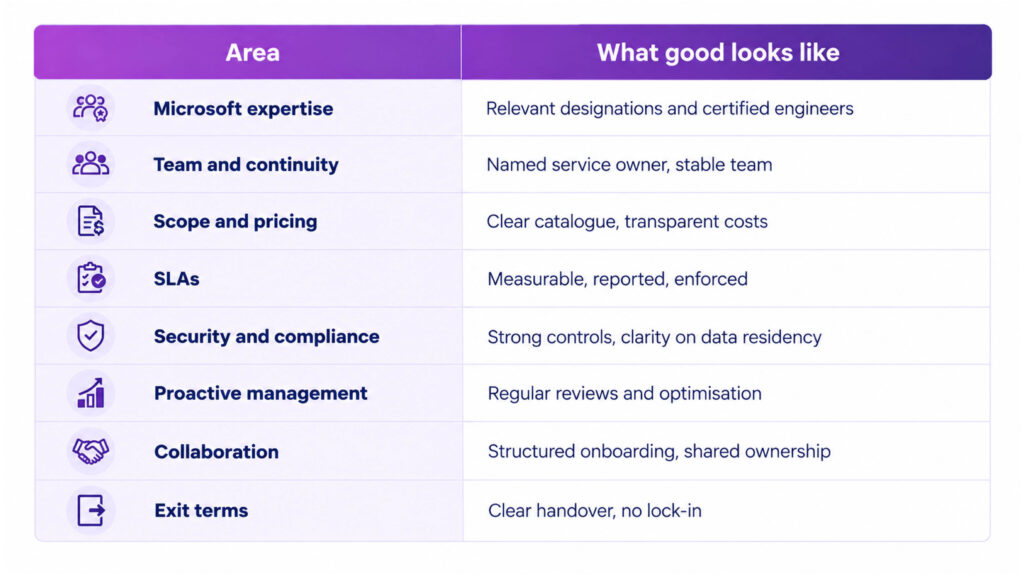
Use this simple framework to compare providers consistently. Rate each from 1 to 5 and weight the categories by what matters most to your business.
Red flags to watch for
- Vague answers on who does the work
- SLAs with no reporting or consequences
- Pricing that is hard to explain or compare
- No mention of security until you ask
- Reluctance to provide references from similar organisations
- Long contracts with difficult exit clauses
Choose a partner, not just a vendor
Choosing a Microsoft managed services provider is less about finding the lowest price and more about finding the team you would trust with the systems your business runs on. The eight questions above, covering expertise, people, scope, SLAs, security, proactivity, collaboration and exit terms, give you a structured way to compare providers and spot gaps before you sign.
If you are weighing your options, we would be glad to be part of the conversation. At iQuasar Software, we help organizations across the region get more from their Microsoft environments, with experienced engineers and a collaborative approach that works alongside your internal team.
Want to see how we approach Microsoft solutions? Explore iQuasar’s Microsoft Solutions Partner page and get in touch to discuss the right support model for your business.
This guide is a general overview. Program requirements, designations and service terms change over time, so confirm current details directly with Microsoft and the provider you evaluate.