


In today’s fast-moving digital landscape, choosing the right web development framework is critical. Recent findings indicate that such choices are of great significance: 84% of those in the developer community take into account performance and scalability issues while making decisions; 55% feel it has major effects on how projects turn out. When deciding which option is best, there are many options, such as Django and NextJS.
This blog will explore popular frameworks, key selection factors, and real-world examples to help you make an informed choice for your next project.
Popular Web Development Frameworks
The web development landscape offers various frameworks to enhance project efficiency. Here are the top options with their key features:
- Next.js, built on React, offers high performance with server-side rendering and exceptional SEO support. Its strong scalability and backing from a robust community make it a top choice for developers looking to create efficient web applications.
- Angular provides a comprehensive solution for building complex applications. While it has a steep learning curve, its power and robust tooling, supported by Google, make it an excellent choice for large-scale projects requiring intricate functionality.
- Vue.js is known for its ease of learning and versatility, making it suitable for developers at all levels. With moderate performance and a growing community, Vue.js is adaptable for both small and large projects, providing flexibility without compromising on functionality.
- Django, a Python-based framework, stands out for its strong security features and rapid development capabilities, thanks to its extensive built-in tools. It is particularly well-suited for content-heavy websites, offering a solid foundation for secure and efficient development.
- Ruby on Rails follows a “Convention over Configuration” philosophy, allowing for rapid prototyping and development. Its strong community support and focus on simplicity make it an ideal choice for developers looking to quickly bring their ideas to life without getting bogged down in configuration details.
Comparative Analysis of Frameworks
Here’s a comparative analysis of these frameworks based on several criteria:
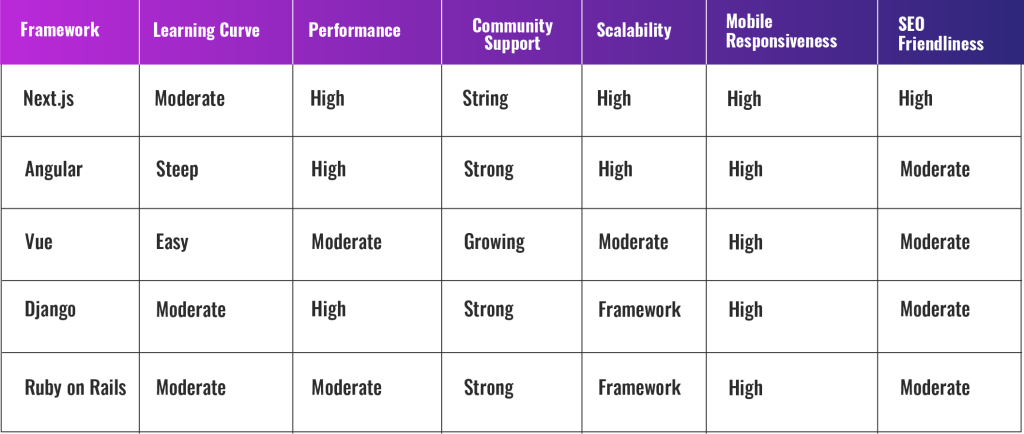
Note: “High” indicates top-tier performance or support, “Moderate” suggests good but not exceptional, and “Growing” implies increasing popularity and support.
Factors to Consider When Choosing a Web Development Framework
When choosing a framework, consider the following aspects:
- Project requirements: Consider the type of project (SSaaS, CMS, e-commerce). For example, a website with a lot of updated content should often use the Django framework.
- Scalability: Ensure the framework can handle future growth. Next.js, for example, is known for its excellent scalability, making it suitable for projects expected to grow rapidly.
- Team Expertise: Choose a framework your team is familiar with. If your team excels in Python, Django might be the best choice, reducing the learning curve and speeding up development.
- Community Support: A strong community provides valuable resources and third-party tools. Angular and React (used by Next.js) have some of the largest developer communities, offering extensive support and resources.
- Performance: Evaluate the framework’s speed and efficiency. Next.js is known for its high performance, particularly in server-side rendering scenarios.
- Learning Curve: Consider how easy it is to learn the framework.
- Security: Check for built-in security features. Django is renowned for its “secure by default” approach, making it a strong choice for projects with high-security requirements.
- Mobile-First Design: Ensure the framework supports responsive and adaptive design. All modern frameworks support this, but some, like Angular, have built-in mobile optimization features.
- Integration Capabilities: Look at how easily it integrates with other tools and services. For example, Ruby on Rails has a large number of gems (plugins) that can increase its capabilities.
Real-world Examples and Case Studies
Here are some real life examples for the application of web development frameworks for different needs:
- E-commerce Giant: Next.js for Scale and SEO:
Many companies have reported significant improvements in performance and SEO after adopting Next.js. For example, the Next.js website showcases various success stories from companies that have seen improvements in page load times and SEO rankings after implementing the framework.
- Media Powerhouse:
Many media companies have adopted Django for content management due to its robust security features and scalability. Its built-in admin interface and ORM make it particularly suitable for efficiently handling large volumes of content. Major media and tech companies like Instagram, Mozilla, and NASA use it for various applications.
Conclusion:
For a project to succeed, selecting the best web development framework is essential for striking a balance between performance, scalability, and community support. As framework technologies rapidly evolve, staying informed is essential. Whether opting for React, Angular, Vue.js, or others, ensure your choice meets both current and future needs. At iQuasar Software, we excel in tailoring framework solutions to optimize your web development projects. Performance optimization, scalable architecture design, customisation, and framework selection are the areas of expertise for our skilled team. Working with us gives you access to customized solutions that make the most of cutting-edge web frameworks, guaranteeing the effectiveness and success of your project. Get in touch with iQuasar Software right now to find out how our web development services can turn your concepts into scalable, effective online solutions.