The Fundamentals
1. Is PHP inherently insecure?
No. Modern PHP (8.x) has strong security primitives: native password hashing (password_hash), PDO prepared statements, typed properties, stricter type handling and a maintained ecosystem. The reputation comes from the volume of legacy code, the low barrier to entry (which produces inconsistent code quality), and the huge plugin ecosystems around PHP-based CMS platforms.
Treat PHP risk as an application lifecycle risk, not a language risk. A web-tempered PHP application on a supported runtime can be as defensible as one built on any other stack.
2. What arextensivee most common PHP vulnerabilities?
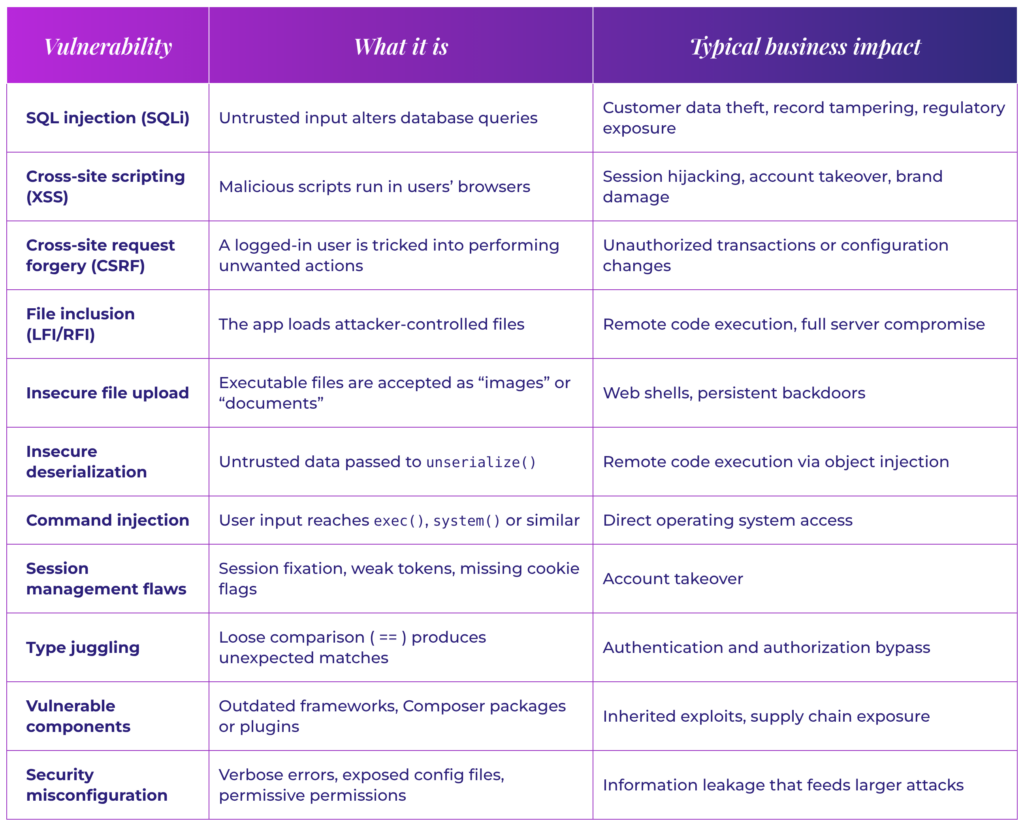
3. Which of these matter most?
Rank them by exploitability and blast radius. In practice, the highest-impact items are usually:
- Outdated runtimes and third-party components. Attackers automate scanning for known CVEs, so unpatched systems are found within hours or days of disclosure.
- Injection flaws (SQLi, command injection, deserialization). These can lead directly to data exfiltration or remote code execution.
- Broken authentication and access control. These are quiet, hard to detect, and often the root cause of reportable breaches.
Business and Executive Questions
4. What does a PHP vulnerability actually cost the business?
Direct costs include incident response, forensics, legal counsel, notification and credit monitoring. The larger costs tend to be indirect: downtime, lost transactions, contract penalties, customer churn, and the diversion of engineering capacity from roadmap work to remediation. For organizations selling to regulated or government buyers, a security incident can also affect eligibility and renewals.
The useful executive framing is that unpatched PHP applications carry a standing liability. The cost accrues quietly until an incident converts it into a loss.
5. How does this connect to compliance?
Most major frameworks expect you to manage exactly these risks. PCI DSS requires secure development practices and timely patching for systems handling card data. HIPAA’s Security Rule requires risk analysis and safeguards for systems handling protected health information. SOC 2 and ISO 27001 both expect documented vulnerability management, change control and access control.
An auditor will not accept “we run PHP and it’s fine” as evidence. They will ask for patch cadence, scan results, remediation SLAs and testing records.
Also read: What Is Legacy Application Modernization, and When Does Your Business Need It?
6. What should executives ask their technology leaders?
These questions tell you quickly where you stand:
- Which PHP versions are running in production, and are they all still receiving security fixes?
- What is our inventory of third-party packages and plugins, and who owns patching them?
- How long does it take us to remediate a critical vulnerability, from disclosure to production fix?
- When did we last run an independent penetration test or code-level security review?
- Are security checks automated in our delivery pipeline, or do they depend on manual effort?
- Which PHP applications are business-critical but have no active owner or maintenance budget?
Vague answers to these are the most reliable early indicator of risk.
Technical Questions
7. Why does PHP version matter so much?
Because security fixes only ship for supported releases. Once a branch reaches end of life, newly discovered vulnerabilities in it simply stay unpatched. Several widely deployed branches (7.4, 8.0 and now 8.1) are already past end of life, yet still run in production at many organizations, often because an application depends on deprecated behavior. The risk is real and has been exploited. In 2024, CVE-2024-4577, an argument injection flaw affecting PHP-CGI on Windows, was exploited at scale within days of disclosure.
Check the official support calendar at php.net/supported-versions and set an upgrade policy that keeps you on a supported branch with margin.
8. How do we prevent XSS and CSRF?
For XSS, apply context-aware output encoding (htmlspecialchars() with ENT_QUOTES and an explicit charset, or a template engine that auto-escapes), and deploy a restrictive Content Security Policy as defense in depth. Framework templating such as Blade or Twig handles escaping by default, so avoid bypassing it.
For CSRF, use per-session anti-forgery tokens on every state-changing request and set SameSite on session cookies. Laravel, Symfony and most mature frameworks provide this out of the box. Bespoke applications often do not.
9. Are frameworks like Laravel and CMS platforms like WordPress safer?
Frameworks are generally safer than hand-rolled code, because they centralize security controls such as input validation, CSRF protection, hashing and escaping. They are not immune. Laravel, Symfony and others have had serious CVEs, and misconfiguration (for example, leaving debug mode enabled in production) has caused real incidents.
With WordPress and similar CMS platforms, the core is typically well maintained. The bigger exposure is the plugin and theme layer, where quality varies widely and abandoned plugins are common. Treat every plugin as third-party code you are accountable for.
10. How should we manage dependency risk?
- Maintain a software bill of materials (SBOM) for each application.
- Run
composer auditand a software composition analysis (SCA) tool in CI. - Pin versions, review updates, and remove unused packages.
- Monitor advisories for the frameworks and plugins you rely on, and assign an owner for each.
Supply chain compromise is now a mainstream attack path, so “we only use popular packages” is not a control.
11. What belongs in a PHP server hardening baseline?
- Disable
display_errorsin production and log errors privately. - Set
expose_php = Offand restrict dangerous functions where the application does not need them. - Enforce HTTPS, HSTS and secure cookie flags (
Secure,HttpOnly,SameSite). - Keep uploaded files outside the web root, validate type and content, and never execute them.
- Apply least-privilege file permissions and separate runtime users.
- Place a web application firewall (WAF) in front of internet-facing applications as a compensating control, not a substitute for fixing code.
Process and Strategy
12. How do we test PHP applications for vulnerabilities?
Layer your testing so each method covers the others’ blind spots:
- SAST (static analysis) catches insecure patterns in source code early.
- DAST (dynamic testing) probes the running application the way an attacker would.
- SCA flags known-vulnerable dependencies.
- Manual penetration testing finds business-logic and access-control flaws that automated tools routinely miss.
- Code review with a security checklist for high-risk features such as authentication, payments and file handling.
Automate the first three in your CI/CD pipeline so every release is checked, and schedule manual testing at least annually and after major changes.
13. When is patching not enough, and modernization the right call?
If an application is pinned to an end-of-life PHP version, depends on abandoned libraries, has no tests, and only one person understands it, patching becomes a recurring tax with diminishing returns. At that point the question shifts from “how do we patch this?” to “what is the lowest-risk path to a supported architecture?” That might mean an incremental upgrade, a framework migration, or a phased rebuild.
The decision is a business one. Compare the annual cost of keeping the legacy system secure and running against the one-time cost of modernizing it, and include the cost of an incident in the comparison.
14. What does a sensible 90-day plan look like?
- Days 1–30: Inventory and triage. Catalog every PHP application, its version, owner and data sensitivity. Identify anything on an unsupported runtime or exposed to the internet.
- Days 31–60: Close the critical gaps. Patch or upgrade high-risk systems, remove unused plugins and packages, and fix confirmed injection and authentication findings.
- Days 61–90: Make it repeatable. Add automated SAST, DAST and SCA to delivery pipelines, define remediation SLAs by severity, and set a recurring reporting cadence to leadership.
Conclusion
PHP vulnerabilities are rarely exotic. The same categories appear year after year: injection, broken authentication, vulnerable components and misconfiguration. That predictability works in your favor. These risks can be inventoried, measured and reduced through supported runtimes, disciplined dependency management, secure coding standards and automated testing in the delivery pipeline.
For executives, the useful shift is from asking “is PHP safe?” to asking “do we have the governance to keep our PHP estate safe?” If you cannot quickly answer which versions you run, who owns each application, and how fast you can remediate a critical flaw, that is where to start.
At iQuasar Software, we help organizations assess, secure and modernize their application portfolios, from security-focused testing and DevOps automation to legacy modernization and long-term engineering support. Our work is backed by ISO 27001:2022 certification for information security. If you want a clear view of your PHP risk and a practical plan to reduce it, book a free consultation with our team.