1. Key Takeaways
- An AI agent is a single, tool-using system built for a defined task. Agentic AI is a broader approach in which one or more agents plan, coordinate, and adapt toward a goal with less step-by-step direction.
- The difference is a spectrum of autonomy, not a hard line. Vendors and researchers use both terms loosely, so define them internally before you buy or build.
- Integration effort and risk rise with autonomy. More autonomy means more systems touched, more state to manage, and a larger blast radius when something goes wrong.
- Most organizations should start with bounded AI agents on well-understood workflows, then graduate to coordinated, agentic designs where the business case and controls justify it.
- Whichever you choose, the foundation is the same: a governed tool layer, per-agent identity, least-privilege access, human approvals for consequential actions, and full audit trails.
The Short Answer
2.1 What Is an AI Agent?
An AI agent is a software system that uses a language model to interpret a request, decide which tools to call, and complete a defined task, such as answering a customer query, scheduling a meeting, or updating a CRM record. It acts within a narrow scope, usually as a single entity following a loop of reasoning, acting, and observing results. The ReAct pattern, which interleaves reasoning with tool use, is a widely cited example of this loop.
2.2 What Is Agentic AI?
Agentic AI describes systems designed to pursue goals with greater independence. They typically break a goal into sub-tasks, assign them to specialized agents, share memory across steps, and adjust the plan as conditions change. A recent conceptual taxonomy published in Information Fusion characterizes agentic AI by multi-agent collaboration, dynamic task decomposition, persistent memory, and coordinated autonomy, in contrast to the narrower, task-specific nature of individual AI agents.
2.3 A Note on Terminology
The terms are not standardized. Some teams call any LLM that uses tools “agentic”; others reserve the word for multi-agent systems. For business purposes, the useful question is not which label applies, but how much autonomy, memory, and coordination the system has, because those determine integration scope and risk.
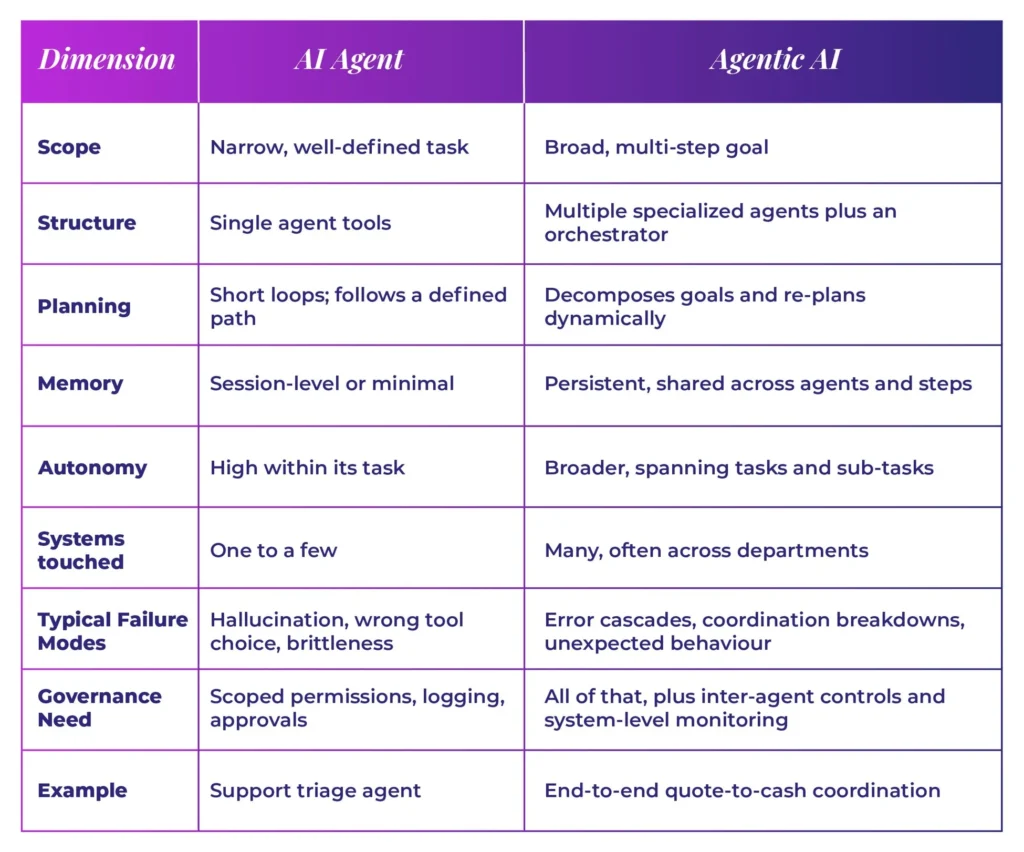
3. Side-by-Side Comparison
4. Why the Difference Matters for Integration
4.1 Blast Radius
A single agent with three tools can only do three kinds of things. A coordinated system with dozens of tools across ERP, CRM, billing, and email can do far more, including more damage. Integration design must size permissions to the smallest scope that completes each sub-task, not to the combined needs of the whole system.
4.2 State and Memory
Simple agents can often be stateless: everything needed arrives in the request. Agentic systems carry state across steps and sometimes across sessions. That raises questions integration teams must answer up front: where memory lives, who can read it, how long it is retained, and how stale or poisoned entries are corrected.
4.3 Coordination and Interfaces
As soon as multiple agents collaborate, you need clear contracts between them: what each can request, what each returns, and who arbitrates conflicts. Standard interfaces help. The arget=”_blank” rel=”noopener”>Model Context Protocol standardizes how applications expose tools and data to models, so several agents can reuse the same governed connection to a system instead of each building its own.
4.4 Failure Modes
A wrong answer from one agent is an error. A wrong answer passed through three downstream agents that each act on it is a cascade. Agentic designs need validation at every handoff, circuit breakers that halt a workflow when confidence drops, and observability that traces a decision across agents end to end.
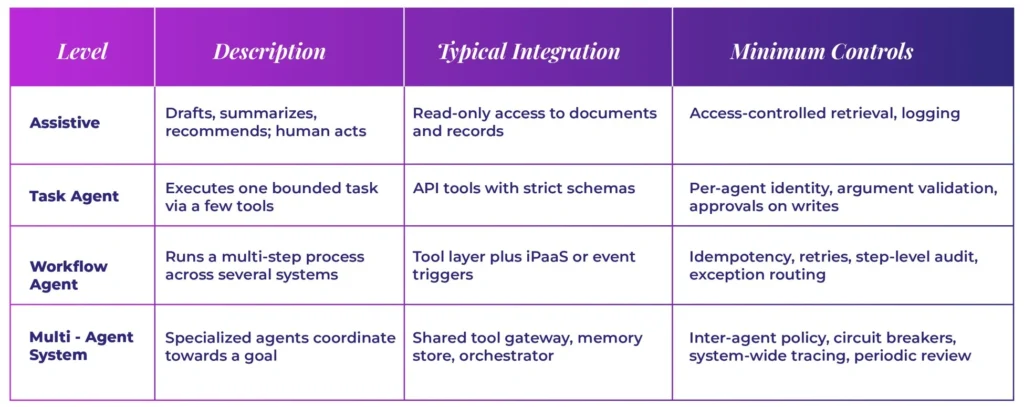
5. Integration Requirements by Autonomy Level
Use this ladder to match controls to the level of autonomy you intend to deploy.
6. Three Business Scenarios
6.1 Support Triage: An AI Agent
A support agent reads an incoming ticket, classifies it, looks up the customer in the CRM, drafts a reply from the knowledge base, and routes it to the right queue. Three or four tools, read-heavy, reversible actions. This is a strong first project: the value is measurable (handling time, first-response time) and the risk is contained.
6.2 Procure-to-Pay Exceptions: An Agentic System
When an invoice does not match its purchase order, one agent extracts invoice data, another checks the contract terms, another queries receiving records in the ERP, and an orchestrator decides whether to approve, request a correction, or escalate to a person. The value is higher, but so is the integration surface: ERP, document store, email, and approval tools, all with shared case memory. Add human approval before any payment-related write.
6.3 Quote-to-Cash: Choosing the Level
Quote-to-cash spans CRM, pricing, contracts, ERP, and billing. Many teams begin with Level 2 agents on single steps (draft quote, validate pricing) and connect them into a Level 3 or 4 flow only after each step proves accurate.
7. Which Do You Need? A Decision Guide
7.1 Start with an AI Agent When
- The task is well defined and repeats often.
- Success can be measured with a before-and-after baseline.
- Required systems are few and have reliable APIs.
- Actions are low-risk or easily reversed.
7.2 Move to Agentic AI When
- The goal spans multiple systems, teams, or decision points.
- The path varies case by case and cannot be fixed in advance.
- Context from earlier steps must inform later ones.
- You already have governed tools, monitoring, and approval flows in place.
7.3 Stay with Deterministic Automation When
- The process is stable, rules are explicit, and exceptions are rare.
- Auditors need fully predictable behavior.
- A workflow or rules engine already solves it at lower cost and risk.
A practical test: if you can draw the whole process as a fixed flowchart, use workflow automation. If a model must choose among steps, use an agent. If several decisions must be coordinated with shared context, consider an agentic design.
8. Integration Blueprint for Both
8.1 One Governed Tool Layer
Expose business capabilities as task-level tools (“create_purchase_requisition”, not a dozen raw endpoints). Define each with a strict schema, validate every argument before execution, and route all calls through a single gateway where policy and logging live. OpenAPI definitions are a good starting point for documenting what each tool does.
8.2 Identity per Agent
Give each agent its own identity and use OAuth 2.0 with short-lived, narrowly scoped tokens. In multi-agent systems, scope each agent to its role so a compromised or confused agent cannot reach tools meant for another.
8.3 Orchestration and Handoffs
Make handoffs explicit and typed. Each agent should return structured results that the next step validates, not free text it must reinterpret. Set limits on loop counts, tool calls, and spend per task.
8.4 Observability
Log every prompt, tool call, result, handoff, and approval with a shared correlation ID. OpenTelemetry offers a vendor-neutral way to trace workflows across agents and the systems they call. You should be able to reconstruct any decision end to end.
9. Governance Scales with Autonomy
The more an AI system can decide and do, the more governance it needs. Anchor your program in recognized guidance:
- The OWASP Top 10 for LLM Applications highlights prompt injection and excessive agency (too much functionality, permission, or autonomy) as leading risks. Both grow with every added tool and agent.
- The NIST AI Risk Management Framework provides a voluntary structure of four functions (govern, map, measure, manage) that works for both single agents and multi-agent systems.
- A tiered approval model keeps humans in control: automate low-risk reversible actions, review medium-risk actions after the fact, and require explicit approval for payments, deletions, and external communications.
10. Common Mistakes to Avoid
- Calling everything “agentic” to justify scope. Pick the simplest design that meets the need.
- Jumping to multi-agent systems before one agent works. Prove accuracy on a single step first.
- Over-privileged shared credentials. One admin token across all agents defeats least privilege.
- No validation between agents. Errors compound at every handoff.
- Unbounded loops and spend. Cap iterations, tool calls, and cost per task.
- Skipping evaluation. Re-test whenever prompts, models, or tools change.
- No owner. Every agent needs a named business owner and a technical owner.
11. Conclusion
The distinction between AI agents vs. agentic AI is less about vocabulary and more about autonomy, coordination, and consequence. A single, well-scoped agent can deliver quick, measurable wins with contained risk. Agentic systems unlock larger workflows but demand stronger integration discipline: governed tools, per-agent identity, validated handoffs, and end-to-end observability. Start with the simplest design that works, prove it with metrics, and add autonomy only as fast as your controls can support it.
12. Frequently Asked Questions: AI Agents vs. Agentic AI
Q1. What is the main difference between AI agents and agentic AI?
An AI agent is a single system that uses tools to complete a defined task. Agentic AI refers to systems with greater autonomy that decompose goals, coordinate multiple agents, retain memory, and adapt plans. The difference is one of scope and autonomy.
Q2. Is agentic AI just a bunch of AI agents?
Partly. Agentic systems often use several specialized agents, but the defining features are coordination, shared context, dynamic planning, and goal-driven behavior. Simply running many unrelated agents does not make a system agentic.
Q3. Which is better for my business?
Neither is universally better. Bounded AI agents suit well-defined, repeatable tasks with measurable outcomes. Agentic designs suit complex, variable, cross-system goals, provided you have the controls to support them. Many organizations start with agents and evolve.
Q4. Why does the difference matter for integration?
Autonomy determines integration scope and risk. Agentic systems touch more systems, hold more state, and can propagate errors across steps, so they need stricter permissions, validation at each handoff, and system-wide tracing.
Q5. Do agentic AI systems need more security controls?
Yes. Every added tool and level of autonomy widens the attack surface. Apply least privilege, per-agent identities, input and output validation, and approval gates, and review the OWASP Top 10 for LLM Applications for relevant risks.
Q6. What is the Model Context Protocol, and does it matter here?
MCP is an open protocol that standardizes how applications expose tools and data to AI models. It helps both single agents and multi-agent systems reuse governed connections instead of building one-off integrations. See the specification.
Q7. Can I build agentic AI on my existing systems?
Usually yes. Most organizations add a governed tool layer over existing ERP, CRM, and productivity systems rather than replacing them. Systems without APIs may need modernization or interim workarounds.
Q8. When should I use workflow automation instead?
When the process is stable, rules are explicit, and predictability matters more than flexibility. If the entire process fits a fixed flowchart, deterministic automation is usually cheaper and safer.
Q9. How do I keep humans in control of autonomous systems?
Use tiered approvals: automate low-risk reversible actions, review medium-risk actions after the fact, and require human sign-off for high-risk actions such as payments or external communications. Add circuit breakers that pause workflows when confidence is low.
Q10. How do I measure the value of each approach?
Baseline the target process first, then track hours saved, cycle time, completion rate without correction, error rate, and cost per task. Compare results to the baseline rather than to model benchmarks.
Q11. Which governance framework should I follow?
The NIST AI Risk Management Framework is a widely used, voluntary starting point. Pair it with your existing security, privacy, and compliance policies.
Q12. How can iQuasar help me choose and implement the right approach?
iQuasar starts with an AI Readiness Assessment to identify high-impact workflows and the right level of autonomy, then designs, integrates, and deploys secure agents across your stack. Talk to the team or explore the AI agent development services. Ready to put the right kind of AI to work? Book a free consultation with iQuasar and map your first production workflow.