
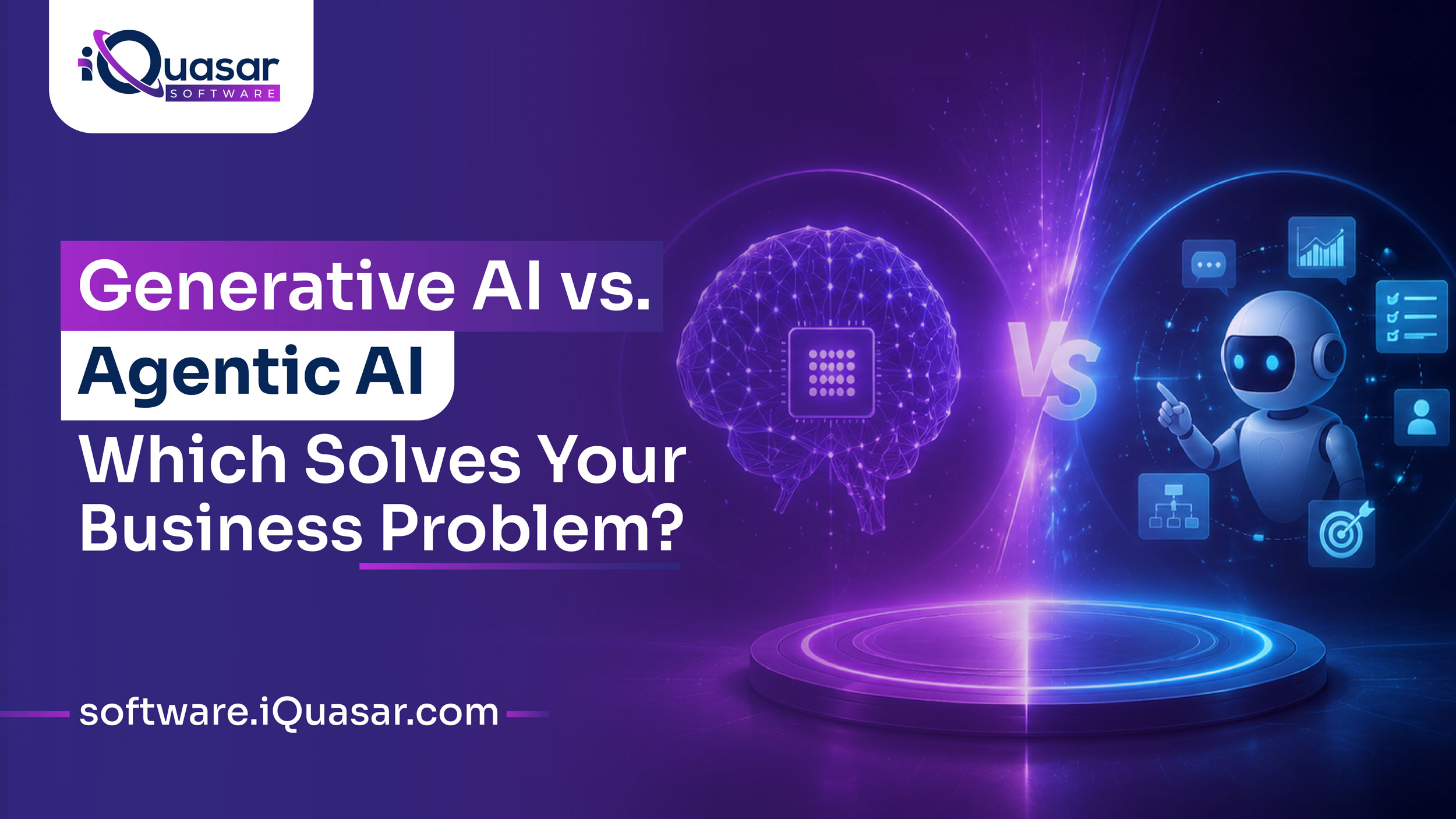
Every executive conversation about Generative AI vs Agentic AI runs into the same jargon wall. Generative AI. Agentic AI. Copilots. Autonomous agents. The vendors selling each one are equally confident it’s the answer to your operational problems. It’s rarely because the technology doesn’t work, but because most organizations haven’t stopped to ask which category their actual business problem belongs to.
That distinction matters more than most AI vendor decks let on. Generative AI and agentic AI aren’t competing technologies; they solve fundamentally different classes of problems, and picking the wrong one for the job is how AI pilots quietly stall out before they ever reach production.
To understand Generative AI vs Agentic AI, it’s important to first understand what each technology is designed to do and the business problems it solves.
What Generative AI Actually Does
Generative AI creates content. Given a prompt, it produces text, images, code, summaries, or recommendations drawing on patterns learned from vast amounts of data, and increasingly, on your own proprietary information through secure LLM integration. It’s reactive by design: a person or system asks, and the model responds.
In practice, this shows up as:
- Content generation at scale — marketing copy, product descriptions, proposal drafts, and customer communications are produced consistently and quickly.
- Conversational interfaces — chatbots and virtual assistants that handle customer questions with natural, human-like responses.
- Analysis and summarization — turning dense documents, contracts, or datasets into digestible insights for faster decision-making.
- Personalization — tailoring recommendations and messaging to individual customers based on behavior and preference data.
Generative AI is exceptionally good at reducing the time and cost of producing something — a draft, an answer, an insight. What it doesn’t do on its own is take action, make a multi-step decision, or execute a workflow from start to finish. It waits for the next prompt.
What Agentic AI Actually Does
Agentic AI is built to operate, not just respond. An AI agent observes its environment pulling data from systems, documents, APIs, or user inputs — decides on a course of action using logic and models, and then acts, triggering workflows, updating systems, generating outputs, or looping in a human only when needed.
This is the difference between a chatbot that answers a billing question and an agent that resolves the billing dispute end-to-end: pulling the invoice, checking the payment history, applying the credit, and confirming the resolution — without a human touching every step.
Where generative AI produces an output, agentic AI completes a task. That distinction is why agentic AI is gaining traction fastest in functions where the bottleneck isn’t a lack of information — it’s the manual effort required to act on it: claims processing, IT support resolution, contract review, financial reconciliation, and supply chain exception handling.
The Real Question: What’s Actually Broken?
The honest way to choose between them isn’t “which is more advanced” — it’s “where does the friction in my business actually live?”
- Choose generative AI when the problem is production speed or communication quality. If your team is bottlenecked producing content, answering routine questions, summarizing information, or generating first drafts of anything from marketing copy to risk reports, generative AI shortens that cycle dramatically with a relatively contained integration effort.
- Choose agentic AI when the problem is process execution. If the real cost is the manual handoffs between systems and people, someone reviewing a document, updating three other systems, and notifying a colleague — that’s a workflow problem generative AI alone won’t fix. It can draft the response; it can’t close the loop.
- Choose both when the problem spans creation and execution. Most high-value use cases actually need generative capabilities for producing content or insight, and agentic orchestration for acting on it. A financial services firm might use generative AI to summarize a loan application and an agent to route it, verify compliance checks, and update the core system — all before a human ever needs to open the file.
Why This Distinction Matters More at the Executive Level Than the Technical One
Engineering teams will often reach for whichever tool is trending. Executives have to reach for whichever tool changes the P&L. Three questions cut through most of the noise:
- Is the bottleneck creation or execution? Generative AI accelerates the former; agentic AI eliminates the latter.
- How regulated or auditable does the outcome need to be? Agentic systems operating autonomously in regulated environments — finance, healthcare, government contracting require deliberate guardrails, human-in-the-loop checkpoints, and audit trails from day one, not as afterthoughts.
- What’s the cost of a wrong decision made autonomously? Generative AI’s worst-case failure is a bad draft someone catches before it ships. Agentic AI’s worst-case failure is an action taken in a live system. That risk profile should directly shape how much autonomy you grant an agent and where you keep a human in the approval chain.
The Executive Takeaway
Generative AI vs agentic AI aren’t a menu you pick one item from; they’re two different capabilities that solve two different classes of business problems, and the fastest way to waste an AI budget is to deploy the wrong one against the wrong bottleneck. The organizations getting real ROI from AI in 2026 aren’t the ones chasing the most autonomous system possible. They’re the ones that diagnosed whether their problem was a content and insight gap or a process execution gap and then built accordingly, with the right integration, governance, and human oversight built in from the start.
At iQuasar, we help executives make exactly that call, assessing where generative AI accelerates output, where agentic AI can safely take on execution, and how to integrate either into your existing systems without disrupting the operations that already work. If your organization is trying to figure out which AI approach actually solves your business problem, that’s the conversation worth having before the next pilot project, not after it stalls.