
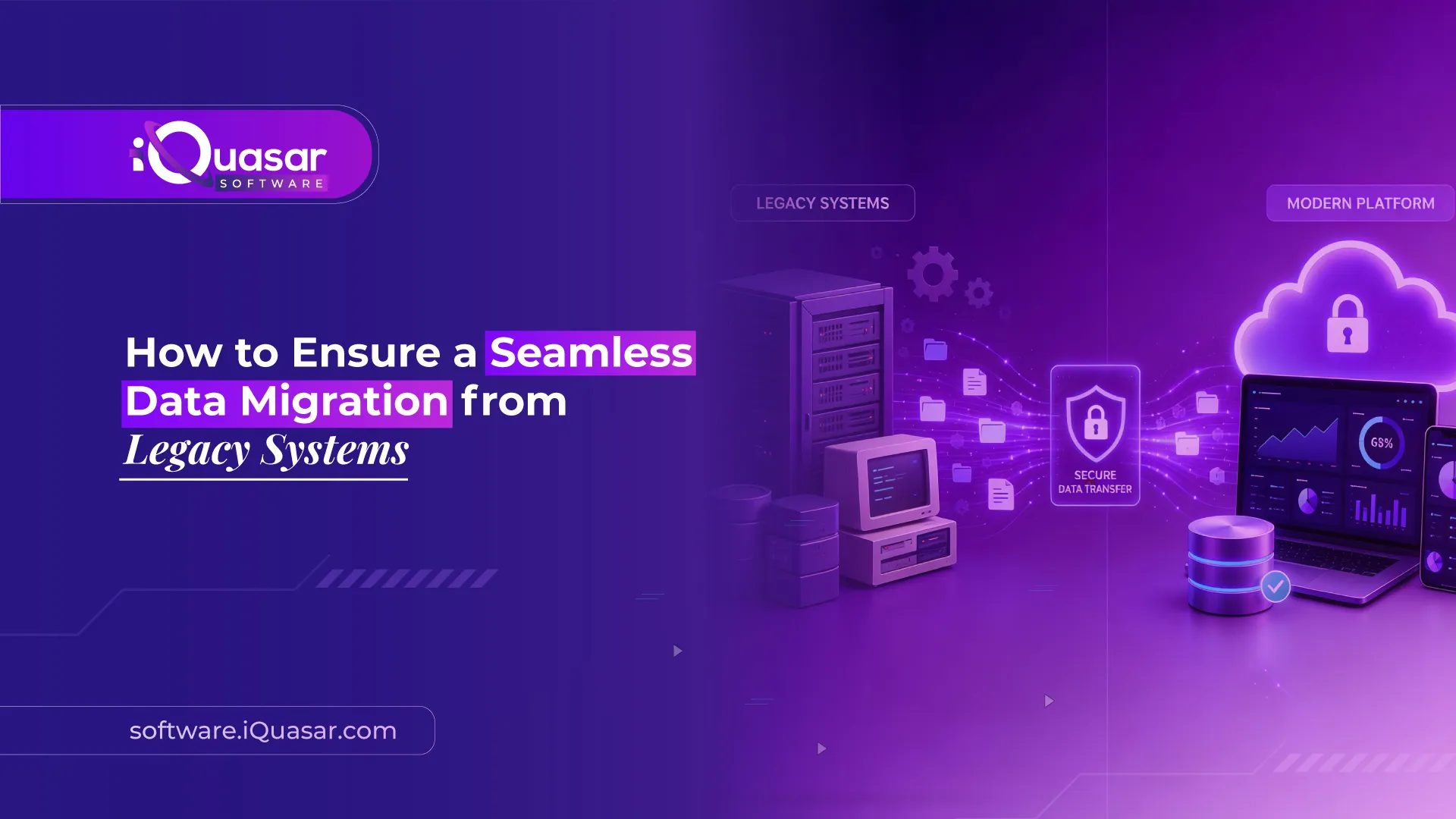
Data is often described as the “new oil,” but for many established enterprises, that oil is trapped in rusted, underground legacy tanks. Data migration from legacy systems is no longer a mere IT checklist item; it is a high-stakes surgical procedure that determines whether your organization can actually leverage AI, real-time analytics, and hyper-personalization. The cost of downtime during a data migration can be staggering: some manufacturing migrations experience downtime valued at US$9,000 per minute. This stark figure underscores a broader truth: data migrations are not merely IT projects but strategic moves that determine time-to-market, cost efficiency, and competitive advantage. In this blog, we examine how executives can steer a seamless Data Migration from Legacy Systems by aligning scope, architecture, governance, and enablement to measurable business outcomes. The aim is to deliver a practical blueprint you can adapt to your industry, risk profile, and regulatory requirements.
The failure rate for large-scale data migrations remains stubbornly high, often due to a lack of executive-level alignment. To ensure a seamless data migration from legacy systems, leaders must look beyond the “move” and focus on data integrity and utility.
The Modern Challenges of Data Migration from Legacy Systems
Legacy systems—often decades old—carry “hidden” risks that don’t appear on a standard spreadsheet:
- Decaying Metadata: Tribal knowledge often replaces formal documentation, leaving the “why” behind data structures a mystery.
- Hard-Coded Logic: Business rules are often embedded in the legacy application’s code rather than in the database itself.
- Data Gravity: The sheer volume of legacy data can make movement slow, expensive, and prone to latency.
Three Pillars of a Seamless Migration Strategy
To move from a legacy “anchor” to a modern “engine,” executives should champion these three strategic pillars.
1. The “Clean-Room” Approach (Data Quality First)
The biggest mistake in migration is “Lift and Shift.” Moving poor-quality data from a legacy system to a modern cloud environment only results in an expensive mess.
- The Solution: Implement a Data Observability layer before the move. This involves profiling your data to identify duplicates, orphans, and inaccuracies.
- Executive Insight: Treat migration as a “Spring Cleaning.” If data hasn’t been accessed in five years, archive it to low-cost cold storage rather than migrating it to your high-performance production environment.
2. The “Bridge and Switch” Strategy (Incremental Migration)
The “Big Bang” migration—where you flip a switch over a weekend—is the primary cause of catastrophic downtime and panicked rollbacks.
- The Solution: Use Change Data Capture (CDC) to create a real-time bridge. This allows the legacy and new systems to run in parallel while staying synchronized.
- The Benefit: You can migrate one business unit or one function at a time. If something breaks, the impact is contained, and the “rollback” is simply a matter of reverting to the legacy source.
3. Automated Validation & Reconciliation
Manual spot-checking of migrated data is insufficient for 2026 compliance standards and the precision required for AI training.
- The Solution: Deploy Automated Reconciliation Frameworks. These tools compare the source (Legacy) and target (Modern) at the record level to ensure 100% parity.
- Focus on Compliance: Ensure your migration pipeline includes automated “masking” or “anonymization” for sensitive PII (Personally Identifiable Information) to meet evolving global privacy regulations during transit.
The Migration Maturity Matrix
| Phase | Strategic Focus | Executive Goal |
| Discovery | Inventory & Governance | Identify “What” we own and “Who” owns it. |
| Cleansing | Deduplication & Standardizing | Ensure the data is fit for modern AI models. |
| Execution | CDC & Parallel Running | Zero-downtime transition for end-users. |
| Validation | Automated Integrity Checks | 100% accuracy and regulatory compliance. |
Best Practices for IT Decision Makers
- Prioritize Business Continuity: Your migration strategy must account for the “Interim State”—the period when some data is in the old system and some is in the new system. Ensure your APIs can talk to both.
- Incentivize Data Ownership: Migration is often seen as an “IT problem.” Appoint “Data Stewards” from the business side to validate that the migrated data actually makes sense for their workflows.
- Budget for the “Tail”: Most migrations are 90% done for a long time. Budget specifically for the decommissioning of the legacy system to ensure you aren’t paying for two licenses indefinitely.
Key Takeaways
- Focus on governance as a precondition for reliable migration; semantic governance reduces post-migration reporting conflicts and builds trust in data across the organization.
- Choose the migration approach (rehost, replatform, replace) based on system criticality, regulatory constraints, and desired speed to value; cloud-native design often yields the strongest long-term benefit.
- Invest in automated, end-to-end data validation to catch issues early and maintain data integrity across ETL pipelines; real-time validation minimizes risk during migration.
- Run pilot migrations and staged rollouts to de-risk the program, validate performance, and secure executive confidence before full-scale adoption.
- Prepare for AI/Analytics readiness by ensuring data quality and governance foundations are in place, as data readiness has become a core predictor of modernization ROI.
Final Thought: Migration as a Competitive Advantage
A seamless migration doesn’t just reduce IT costs; it unlocks the agility required to outpace competitors. When your data is freed from legacy constraints, your organization can pivot in days rather than months. Data Migration from Legacy Systems is a strategic program, not a one-off IT project. By aligning migration strategy with governance, architecture, and execution discipline, executives can reduce risk, accelerate time-to-value, and unlock measurable business benefits such as improved decision speed and cost efficiency.
“A successful data migration is invisible to the customer, but revolutionary for the business.”
As you review your 2026 roadmap, is your migration strategy focused on moving files or on advancing the business? To explore how iQuasar Software can help you accelerate data migration, modernization, and AI-enabled outcomes, visit iQuasar Software or contact us to discuss your scenario.