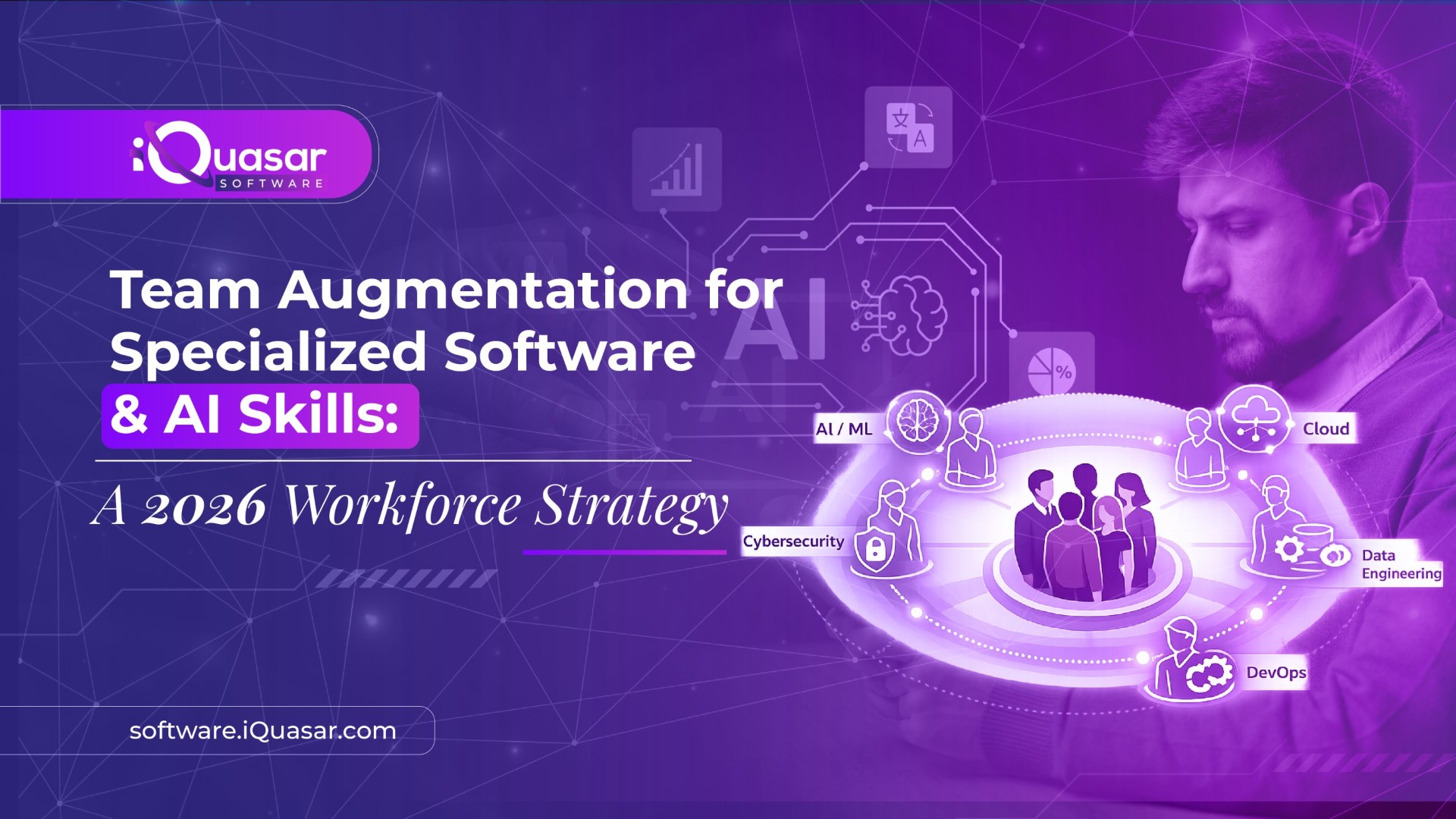
By 2026, the biggest constraint on software and AI delivery won’t be funding or tools; it will be access to the right skills at the right moment. Organizations are discovering that even with strong internal teams, critical initiatives stall when niche expertise is needed quickly and for limited windows of time. The problem isn’t a lack of talent in the market—it’s that traditional hiring models are incompatible with how modern software and AI systems are built. AI initiatives now move in phases: experimentation, model development, infrastructure setup, deployment, and governance. Each phase demands a different, highly specialized skill set, often for months—not years. Hiring full-time for every specialization is slow, costly, and unsustainable. Waiting isn’t an option either.
This is why IT staff augmentation is no longer a tactical staffing choice. In 2026, it is becoming a core workforce strategy for software and AI-driven organizations—one that enables speed, control, and precision without long-term hiring risk.
Why 2026 Demands a New Workforce Strategy
Software and AI development are no longer centered around generalist roles. Today’s projects require expertise in areas such as machine learning, MLOps, cloud-native architectures, data engineering, AI security, and platform scalability. At the same time, organizations face:
- Longer hiring cycles for niche technical roles
- Intense competition for AI talent
- Budget constraints and pressure to show ROI
- Uncertainty around long-term skill requirements
As a result, companies are shifting from “headcount-based planning” to “capability-based workforce strategies”.
Why Traditional Teams Fall Short
For specialized software and AI roles, traditional hiring presents several challenges:
- Speed: Hiring cycles often exceed project timelines
- Cost: Niche AI talent commands premium compensation
- Utilization risk: Skills may be underused after the delivery phases
- Skill obsolescence: AI tools and frameworks evolve rapidly
In many cases, organizations don’t need permanent roles—they need targeted expertise, delivered on demand.
IT Staff Augmentation: The 2026 Strategy
Team augmentation allows organizations to extend their internal teams with specialized software and AI professionals for defined scopes and durations. Unlike outsourcing entire projects, augmented professionals:
- Work directly with internal teams
- Follow existing processes, tools, and standards
- Integrate into product, engineering, and delivery workflows
This approach provides flexibility without losing control.
Where IT Staff Augmentation Delivers the Most Value
In 2026, team augmentation is particularly effective for:
1. AI Development and Deployment
- Model development and tuning
- Moving AI from proof-of-concept to production
- Building scalable inference pipelines
2. MLOps and Infrastructure
- Setting up CI/CD pipelines for AI
- Monitoring, retraining, and versioning models
- Cloud optimization for AI workloads
3. Platform and Product Engineering
- Scaling software platforms
- Modernizing legacy systems
- Accelerating feature delivery
4. AI Governance and Security
- Implementing data privacy controls
- Establishing auditability and explainability
- Meeting regulatory and enterprise security requirements
Business Impact of Augmenting Software & AI Teams
Organizations adopting team augmentation for specialized skills are seeing:
- Faster time to market for software and AI initiatives
- Lower hiring risk and reduced fixed costs
- Access to high-impact expertise when it’s needed most
- Improved ROI by aligning talent costs with delivery phases
Team augmentation enables teams to stay lean while still executing complex, high-value work.
Key Considerations Before Augmenting AI & Software Teams
To maximize success, organizations should focus on:
- Clear scope and success metrics
- Secure access to systems and data
- Alignment with internal engineering standards
- Knowledge transfer and documentation
- Strong communication between internal and augmented team members
When done well, augmentation feels like an extension of the team, not an external dependency.
Final Thoughts: Building AI-Ready Teams for 2026
In 2026, successful software and AI teams won’t be defined by how many people they employ—but by how effectively they access and deploy specialized skills. IT Staff augmentation is no longer a stopgap solution. It’s a strategic workforce model that allows organizations to innovate faster, manage risk, and adapt to a rapidly changing technology landscape. For companies building the next generation of software and AI capabilities, team augmentation is becoming essential to staying competitive.
At iQuasar Software, we bring proven experience delivering complex software and AI solutions across diverse environments. Our teams are built with specialized, rigorously vetted talent that integrates seamlessly into your engineering workflows—adapting quickly to your tools, processes, and delivery standards. We prioritize structured onboarding, secure system access, and compliance-ready practices to ensure velocity without risk. As your needs evolve, our model is designed to scale teams up or down with precision, giving you the flexibility to move fast without compromising quality or control.