


For many businesses across industries, a mobile app is no longer a luxury-it’s a business necessity. But as you embark on your mobile journey, one crucial decision stands in your way: Should you opt for native vs cross-platform development?
This blog will demystify both approaches, highlight their strengths and weaknesses, and help you make an informed choice that aligns with your business goals.
Understanding the Basics
- Native Development refers to building apps specifically for one platform-iOS or Android-using languages and tools unique to each (Swift/Objective-C for iOS, Kotlin/Java for Android). These apps are tailored to the operating system, offering seamless integration and optimal performance.
- Cross-Platform Development uses frameworks like React Native, Flutter, or Xamarin to create a single codebase that runs on multiple platforms. This approach promises faster development and reduced costs by reusing code across iOS and Android.
Feature-by-Feature Comparison
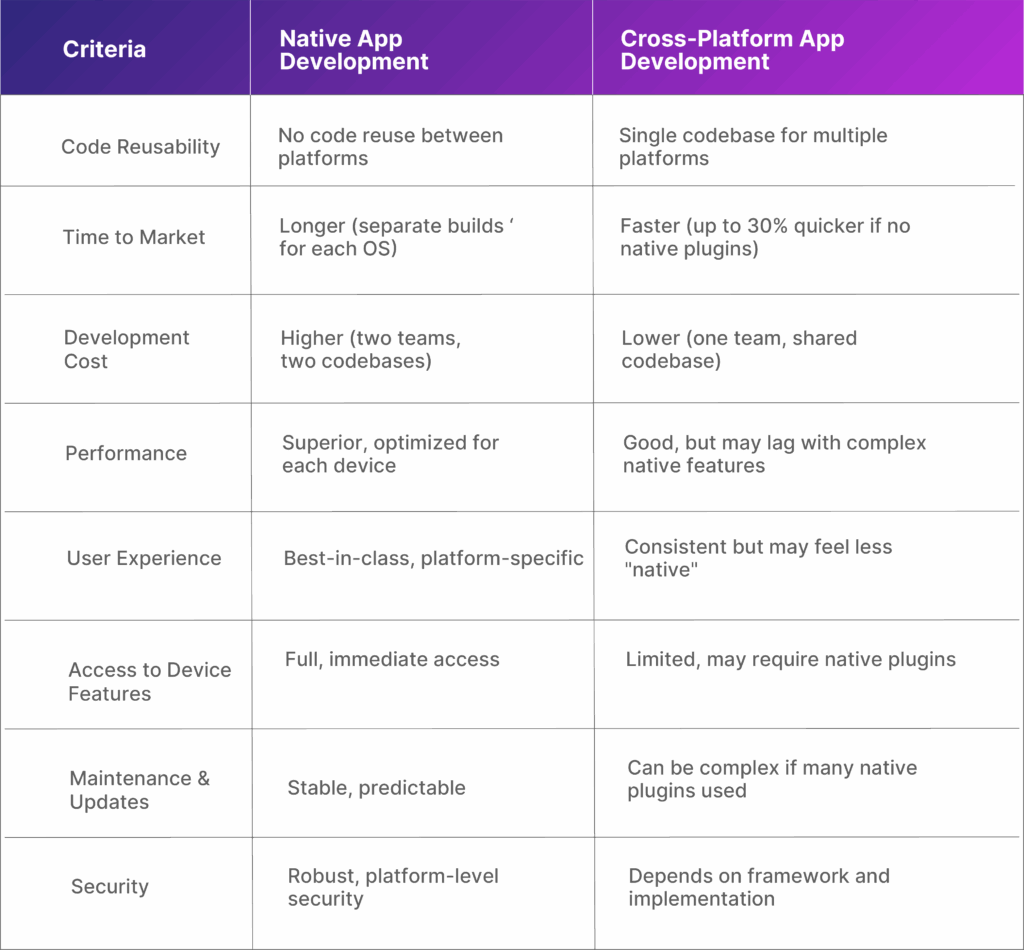
Deep Dive: What Matters for Business Owners
- Code Reusability and Maintenance
- Cross-platform shines here, allowing teams to write code once and deploy everywhere. This can cut development and maintenance time significantly-unless your app needs deep integration with native features. In such cases, you may end up managing three codebases: the shared one, plus native modules for iOS and Android.
- Native development requires writing and maintaining separate code for each platform. While this increases effort, it also gives you full control and predictability.
- Time to Market
- Cross-platform tools can reduce time to market by up to 30% when native plugins aren’t needed. However, if your app requires advanced native features, integrating them can slow things down and increase costs unexpectedly.
- Native development is more time-consuming but offers a steady, predictable pace. You’re less likely to encounter unforeseen delays due to third-party plugin issues.
- Development and Maintenance Costs
- Cross-platform solutions are generally more budget-friendly, especially for MVPs or apps with simple functionality. However, hidden costs can arise if you need to build custom native modules or maintain compatibility with evolving device features.
- Native apps cost more upfront-requiring two specialized teams-but these costs are more transparent and predictable throughout the app’s lifecycle.
- Performance and User Experience
- Native apps deliver the best performance, especially for graphics-intensive or complex applications (think AR, VR, or machine learning). They also provide a user experience that feels perfectly at home on each device, adhering to platform-specific guidelines.
- Cross-platform apps are improving rapidly, but may still struggle with performance or user experience when advanced device features are required or when handling heavy computational tasks.
- Access to Device Features
- Native development allows immediate and unrestricted access to all device capabilities, from sensors to push notifications. This is crucial for apps that rely on hardware integration or cutting-edge OS features.
- Cross-platform frameworks offer access to many features, but may lag behind when new device capabilities are introduced. Workarounds or native plugins can bridge the gap, but at the cost of added complexity.
- Security
- Native apps benefit from robust, platform-specific security features and updates directly from Apple and Google. This makes it easier to implement advanced security measures like encryption and fraud detection.
- Cross-platform security depends on the framework and developer expertise. While secure apps are possible, the extra abstraction layer can introduce vulnerabilities if not managed carefully.
When to Choose Native vs. Cross-Platform
Go Native If:
- Your app demands top-tier performance (e.g., gaming, AR/VR, complex animations)
- You need deep integration with device hardware or OS features
- User experience is your top priority
- Security is mission-critical
- You have the resources for two development teams
Go Cross-Platform If:
- You need to launch quickly on both iOS and Android
- Your app’s functionality is relatively simple or similar across platforms
- You have limited budget or resources
- You want to validate an MVP before investing in full-scale development
Key Takeaways for Business Owners
- Align your choice with business goals: Consider your app’s complexity, performance needs, and budget constraints.
- Beware of hidden costs: Cross-platform is not always cheaper if your app needs extensive native features.
- Think long-term: Maintenance, updates, and scalability should influence your decision as much as initial development speed.
- Prioritize user experience: The best technology is the one that delights your customers and meets your business objectives.
Conclusion
There’s no one-size-fits-all answer. Native development offers unmatched performance and user experience, ideal for feature-rich or mission-critical apps. Cross-platform development is a smart choice for rapid deployment and cost savings, particularly for simpler applications or MVPs.
Evaluate your project’s unique requirements, consult with experienced developers, and choose the path that delivers the most value for your business-today and as your app evolves.
At iQuasar, we help businesses navigate these crucial decisions like Native vs. Cross-Platform with clarity and confidence. Ready to build your next mobile app? Let’s discuss the best approach for your goals. Contact us today.