
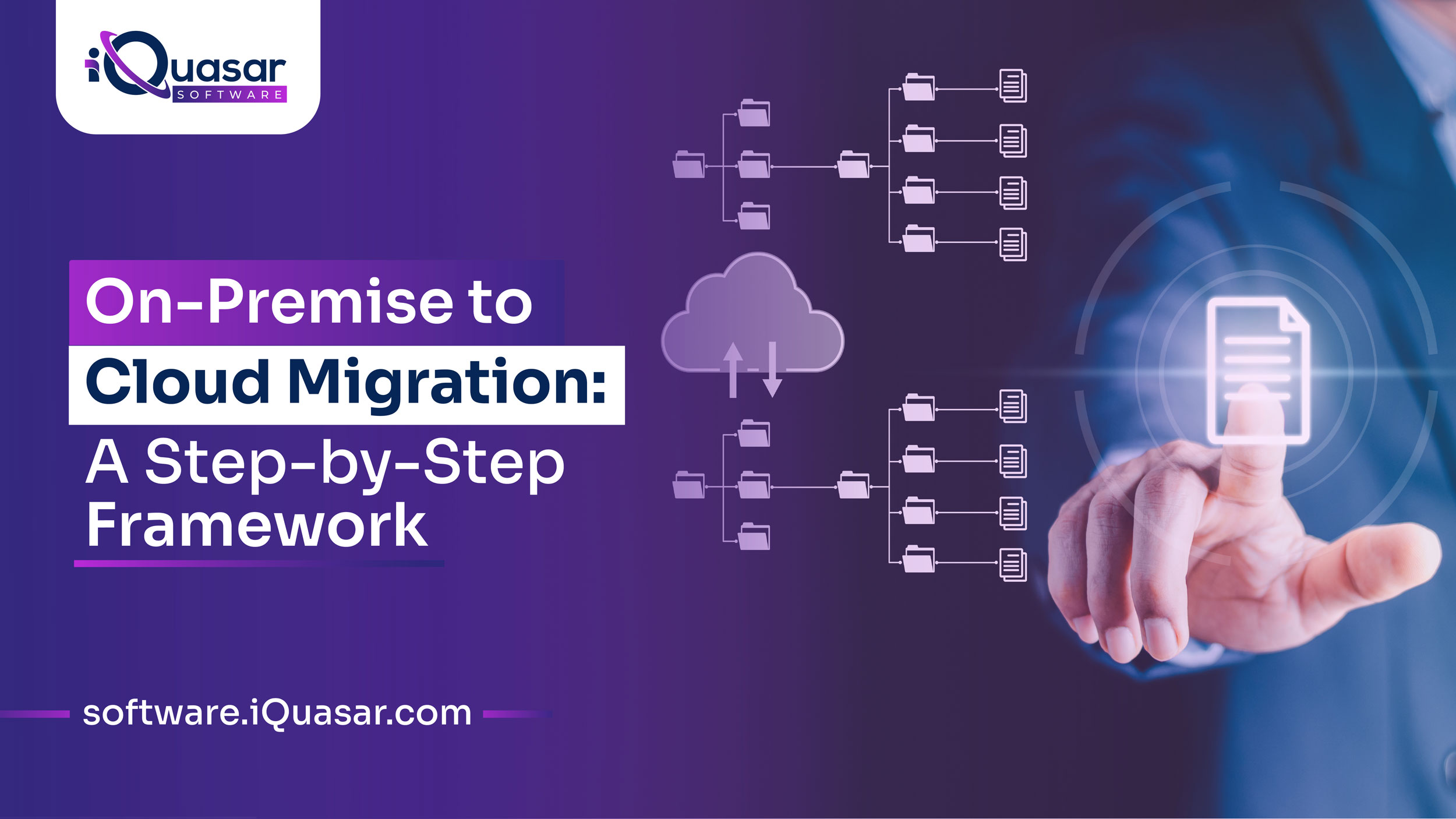
In 2026, the question for most enterprises is no longer if they should move to the cloud, but how to do it without disrupting the business. According to Gartner, worldwide public cloud end-user spending is projected to reach $723 billion by the end of 2025, driven largely by the need to support Generative AI and advanced data analytics.
However, moving from legacy on-premise infrastructure to a modern cloud environment is not a simple “copy-paste” operation. Without a structured framework, organizations face a 14% average cost overrun and significant project delays. This guide provides a battle-tested executive framework for a successful migration.
This guide provides a battle-tested executive framework for a successful On-Premise to Cloud migration. To avoid the “Cloud Paradox” (where costs rise without a proportional increase in agility), executives must look beyond simple server migration and focus on systemic modernization.
1. Addressing Data Gravity and Latency Constraints
One of the most overlooked hurdles in enterprise migration is Data Gravity. As datasets grow, they become difficult to move, pulling applications and services toward them.
- The Latency Trap: If you migrate an application but leave its massive SQL database on-premise due to compliance, you introduce “chatter” latency that can degrade user experience.
- The Solution: Use Edge Computing or Cloud Outposts for data that cannot move, while using asynchronous data streaming (like Apache Kafka) to keep cloud-based analytical engines fed in real-time.
2. The “Refactor vs. Retire” Audit: A Value-Stream Approach
Most frameworks tell you how to move; few tell you what to kill. An aggressive migration is the best time to perform “Application Rationalization.”
- Technical Debt Liquidation: If an application requires a specific legacy OS version that is end-of-life, “Rehosting” it only moves the risk to a different neighborhood.
- The 20% Rule: Typically, 20% of an enterprise’s apps generate 80% of the business value. These should be refactored (rewritten for containers/serverless). The remaining 80% should be either re-platformed or Retired to fund the modernization of the core.
3. Establishing a Cloud Center of Excellence (CCoE)
Migration is 20% technology and 80% people. A CCoE is a cross-functional team (Infrastructure, Security, Finance, and Operations) tasked with setting the “guardrails” of the migration.
- Policy as Code: Instead of a 100-page security manual, the CCoE delivers automated scripts that prevent any developer from launching a non-compliant resource.
- Breaking Silos: By involving the Finance team early, you move from fixed capital expenses (CapEx) to fluid operating expenses (OpEx), preventing “Cloud Shock” when the first bill arrives.
4. Security: Moving to a Zero Trust Architecture
In an on-premise world, you protected the “perimeter.” In the cloud, the perimeter is gone.
- Identity is the New Perimeter: Every service-to-service communication must be authenticated.
- Immutable Infrastructure: Shift your mindset from “patching” servers to “replacing” them. In a mature cloud environment, if a server is compromised or out of date, you don’t log in to fix it; you terminate it and deploy a fresh, pre-configured image from your CI/CD pipeline.
5. The “Day 2” Reality: FinOps and Continuous Optimization
Migration “completion” is a myth. The most successful enterprises treat Day 2—the period after the cutover—as a continuous loop of optimization.
- Predictive Scaling: Use AI-driven tools to scale down environments during non-peak hours.
- The Cost of Idle Resources: Flexera’s 2025 State of the Cloud Report notes that organizations waste an average of 32% of their cloud spend. A robust FinOps practice identifies these “zombie” resources in real-time.
A Phased Implementation for Cloud Success
While the high-level strategy defines your vision, the technical execution of a On-Premise to Cloud migration is a game of precision. To transition from a rigid on-premise data center to a fluid cloud ecosystem without interrupting business continuity, enterprises must follow a rigorous, phased implementation plan. This tactical framework moves beyond theory, breaking the migration into five manageable stages—from initial discovery to the continuous optimization of your new digital footprint.
Phase 1: Assessment and Discovery
Before moving a single byte of data, you must understand your current landscape.
- Inventory Audit: Document all applications, servers, and hardware.
- Dependency Mapping: Use automated tools to identify how applications interact. If you move App A without App B, will it break?
- Cloud Readiness: Evaluate each workload based on its complexity and business value.
Key Stat: McKinsey reports that organizations modernizing legacy systems through cloud adoption can reduce IT costs by nearly 40% while significantly increasing release velocity.
Phase 2: Strategy Selection (The 6 Rs)
Not every application belongs in the cloud in the same way. The industry-standard 6 Rs Framework helps determine the best path for each workload:
| Strategy | Action | Best For… |
| Rehost | “Lift and Shift” | Quick migrations with minimal changes. |
| Replatform | “Lift, Tinker, and Shift” | Optimizing the OS or database for the cloud. |
| Refactor | Rearchitecting | High-value apps need cloud-native features. |
| Repurchase | Drop and Shop | Switching from a custom app to a SaaS (e.g., Salesforce). |
| Retire | Decommission | Getting rid of redundant or obsolete systems. |
| Retain | Keep On-Premise | Apps with strict compliance or technical debt. |
Phase 3: Architecture and Landing Zone Setup
A “Landing Zone” is your pre-configured, secure, multi-account environment in the cloud. Before migration begins, your team must establish:
- Identity and Access Management (IAM): Who has access to what?
- Security Baselines: Encryption, firewalls, and compliance logging.
- Network Topology: Connecting your on-premise data center to the cloud via VPN or dedicated lines (e.g., AWS Direct Connect or Azure ExpressRoute).
Phase 4: The Migration Execution (The Wave Approach)
Avoid the “Big Bang” migration. Instead, execute in waves:
- Pilot Wave: Move low-risk, non-critical workloads to test the plumbing.
- Core Wave: Migrate the bulk of your standard applications.
- Critical Wave: Transition mission-critical databases and high-traffic systems.
Phase 5: Post-Migration Optimization & FinOps
The journey doesn’t end at cutover. Cloud costs are variable, and “zombie resources” can quickly drain budgets.
- Rightsizing: Adjusting instance sizes based on actual performance data.
- Governance: Implementing a FinOps culture to ensure accountability for cloud spend.
- Modernization: Continuing to refactor applications to use serverless or containerized architectures for further cost savings.
The Common Pitfall: The Skills Gap
IDC research indicates that over 80% of enterprises cite a lack of internal cloud expertise as a major hurdle. Security misconfigurations—often caused by human error—are responsible for 55% of cloud data breaches. Partnering with experts for a successful On-Premise to Cloud migration is often the most cost-effective way to mitigate these risks.
Partner with iQuasar Software
Navigating a On-Premise to Cloud migration is complex, but you don’t have to do it alone. iQuasar Software provides the end-to-end expertise required to assess, plan, and execute your migration with zero downtime and maximum ROI. [Contact iQuasar Software today] to schedule a comprehensive Cloud Readiness Assessment and take the first step toward a scalable, secure future.