


It rarely starts with a crisis. It starts with a missed milestone that gets explained away, a status report that is a little too green, a go-live date that quietly moves. Months later, the budget is stretched, the team is exhausted, the vendor and your internal staff are blaming each other, and the people who funded the project want to know what they are getting. If that sounds familiar, you are not alone, and the situation is usually more recoverable than it feels. This article explains how failing software projects get rescued, what software failure experts actually do, and the decisions executives need to make in the first weeks.
How common is project failure?
More common than most leadership teams would like. Research by McKinsey and the University of Oxford, covering thousands of IT projects, found that on average, large IT projects run 45 percent over budget and 7 percent over time while delivering 56 percent less value than predicted. The same study found that software projects carry some of the highest risk of cost and schedule overruns, and that longer projects tend to overrun more. You can read the full findings in McKinsey’s research on delivering large-scale IT projects.
The study focused on large programmes, but the pattern applies more widely: complexity, shifting scope and weak governance sink projects of every size. Failure is not a sign that your team is incompetent. It is a sign that something structural needs to change.
Warning signs your project is going off track
Executives often see symptoms before they understand causes. Watch for:
- Repeated schedule slips with vague explanations
- Rising costs driven by change requests that were not budgeted
- Status reports that do not match reality, such as everything is “amber” for months
- Demos that never quite show the finished feature
- Mounting defects and a testing phase that keeps growing
- Key people leaving, or the same few people carrying the whole project
- Stakeholders disengaging because they no longer believe the dates
- Disputes between you and your vendor over scope, responsibility or quality
One or two of these is normal. Several at once is a signal to act.
Why software projects fail?
Understanding the cause determines the remedy. The most common root causes are rarely purely technical:
- Unclear or shifting requirements. The business never agreed on what “done” means, or the scope keeps growing without a decision about trade-offs.
- Weak governance and ownership. No single accountable executive, or decisions stuck between departments.
- Poor architecture decisions. Early design choices that cannot support scale, integration or future change.
- Underestimated integration. New software has to connect to ageing systems and messy data, and that effort was never fully planned.
- Insufficient testing and quality discipline. Defects found late cost far more to fix than defects found early.
- Skills gaps. The team lacks experience with the platform, the domain or the scale of the project.
- Vendor and communication breakdowns. Misaligned incentives, unclear contracts or too many hand-offs.
- Neglected change management. The system works, but the people it was built for do not adopt it.
What software failure experts actually do?
A good recovery specialist does not arrive with a miracle tool. They bring structure, objectivity and experience of what a failing project looks like from the inside. A typical engagement follows five stages.
1. Stabilise
The first priority is to stop things getting worse. Experts pause non-essential work, freeze scope, protect critical people and establish a single source of truth about where the project stands. This often takes days, not weeks.
2. Assess independently
A structured review examines what has been built, how it was built and whether it can be relied on. It covers:
- Requirements and scope: what was promised against what is actually needed
- Architecture and code quality: whether the foundation is sound
- Testing and defect trends: how stable the system really is
- Delivery process and governance: how decisions get made and who owns them
- Team and vendor capability: whether the right skills are in place
- Budget and timeline reality: what it will genuinely take to finish
Independence matters. People inside a troubled project, whether yours or the vendor’s, often have reasons to soften the picture.
3. Decide: continue, repair, rebuild or stop
This is the executive decision at the heart of every rescue. The honest options are:
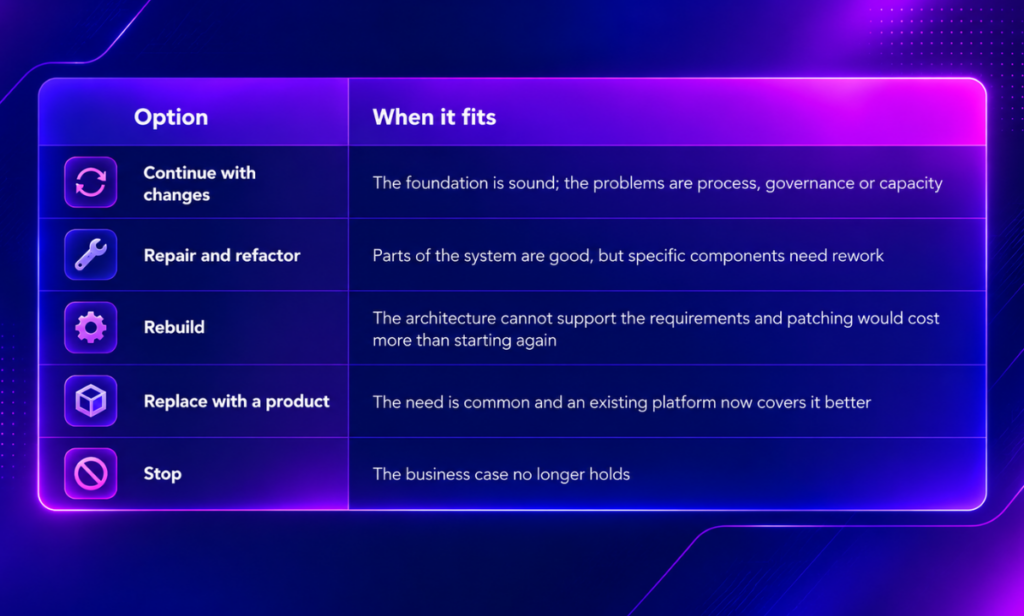
The hardest part is resisting the sunk-cost instinct. Money already spent is gone either way. The right question is the one that delivers the best outcome from here.
4. Reset the plan
A recovery plan is different from the original plan. It is smaller in scope, delivered in shorter increments, with clear acceptance criteria and visible progress every few weeks. The goal is to rebuild confidence by delivering something real, quickly.
5. Strengthen governance and delivery
Experts put in place the practices that were missing: clear ownership, regular steering reviews, honest reporting, automated testing, release discipline and documentation. The aim is not just to finish this project but to make the next one less likely to fail.
Your first 30 days: a practical checklist for executives
Week 1: Face the facts
- Ask for an honest status, including risks the team has been reluctant to raise
- Confirm who is accountable for the outcome
- Pause new scope until you understand where you stand
Week 2: Get an independent view
- Commission a structured assessment from someone outside the project
- Secure access to code, documentation, environments and contracts
- Interview users, sponsors and delivery staff separately
Week 3: Decide the direction
- Review options: continue, repair, rebuild, replace or stop
- Compare the cost to complete with the value still available
- Align the leadership team on one path
Week 4: Reset
- Agree a reduced, prioritised scope for the next phase
- Set short delivery cycles with measurable outcomes
- Reset expectations with the board, users and vendors
How to choose a software failure expert
Not every consultant is suited to recovery work. Ask:
- Have you rescued projects like ours, in our platform and scale?
- Will you give us an independent assessment, including uncomfortable findings?
- How do you separate technical problems from governance problems?
- Will experienced people do the work, or only senior staff during the sales phase?
- How do you handle a situation where the existing vendor is still involved?
- What does a realistic recovery plan include, and how do you measure progress?
- Can you hand over documentation and knowledge so we are not dependent on you?
Be cautious of anyone who promises a quick fix before examining the project, or whose recommendation conveniently requires a large new engagement.
Prevent the next failure
Recovery is also an opportunity to build better habits:
- Tie every project to a measurable business outcome
- Break large programs into smaller deliverables
- Plan integration and data migration early, not late
- Test continuously rather than at the end
- Keep honest reporting, with no penalty for raising problems
- Invest in documentation and knowledge transfer
- Review ageing platforms before they hold new projects back
Conclusion:
A struggling software project is not a verdict on your team or your strategy. It is a problem with causes that can be diagnosed and decisions that can be made. The projects that recover are the ones where leadership steps in early, gets an honest independent view and chooses a direction, even when the direction is to reduce scope or start again.
The longer a failing project continues unexamined, the more it costs, and the harder the conversation becomes. Acting in the first few weeks is almost always cheaper than acting after another quarter of drift.
If you are facing that situation, we can help. At iQuasar Software, our software failure experts work with organizations to assess where a project really stands and to get it moving again, whether that means fixing the integration points through system integration, addressing the ageing platform behind the problem through legacy system modernization, or building what the original project could not deliver, including custom AI agents. Our approach is straightforward: look honestly at the situation, recommend the path that makes business sense and deliver in steps you can see.
Is a project of yours off track? Talk to the iQuasar team for a candid conversation about where it stands and what the options are.