


Software staff augmentation emerges as the gateway to limitless talent and innovation in software development. Recent market analysis forecasts that the outsourced talent market’s exponential growth will soar to an impressive USD 525.2 billion by 2030. With approximately 300,000 jobs outsourced annually in the United States alone, this trend underscores the potential for accessing a diverse pool of skilled professionals globally. Organizations must assemble optimal project teams to maintain a competitive edge in our rapidly evolving landscape. However, this trend also prompts a key question: amidst the dynamic tech environment and shifting project objectives, how can companies choose between the two primary strategies—software staff augmentation vs in-house hiring—to determine the most suitable approach for their specific requirements? Let’s delve into the strategies to aid in selecting the most fitting option for your software project needs.
Software Staff Augmentation Vs. In-house Hiring
Software staff augmentation uses a specialized Information Technology (IT) staffing agency as a partner, allowing access to a diverse pool of developers, designers, and other IT specialists. Together with your present team, these experts cover specific skill gaps and provide additional assistance to reach project deadlines. On the other hand, in-house hiring is the traditional approach to filling vacant positions and involves identifying and selecting qualified candidates from within your company. When these people work for you full-time, they get a thorough understanding of your corporate culture and may even develop a specialization in the project they are given. Staff augmentation is a good alternative for today’s dynamic digital industry, even though in-house hiring promotes a strong business culture and a sense of control through engagement with your team. In this fast-paced environment, staff augmentation provides the flexibility and access to specialized abilities often essential for success.
Let’s explore some key areas to consider while choosing between software staff augmentation vs in-house hiring for your specific needs:
- Project Flexibility and Scalability
Project needs constantly shift rapidly. While a broader and diverse skill set is needed for the development stage, a small agile team may be needed for the initial prototype. The flexibility that staff augmentation offers is unmatched. The team can be easily scaled up or down based on the stage of the project. Require a UI/UX specialist at the stage of development? You may quickly integrate an expert into your process with the aid of an augmentation partner. On the flip side, internal teams may find that growth requires a lengthy and resource-intensive process of hiring and training new staff members.
- Expertise and Skill Diversity
Software development is a complex symphony of specialized skills. In-house teams excel at building a cohesive knowledge base specific to your company’s projects. However, emerging technologies may necessitate expertise outside their current skillset. Staff augmentation bridges this gap. You gain access to a wider talent pool, readily integrating experts in cutting-edge technologies like AI or blockchain for specific needs. This allows you to leverage the latest advancements without lengthy in-house recruitment cycles and associated costs.
- Cost Efficiency and Budget Management
Optimizing costs is essential to any project. Although internal teams provide a feeling of security, they come with high overhead expenses such as infrastructure, benefits, and salary. A more affordable option in the long run is staff augmentation. You only pay for the precise expertise you require, eliminating the burden of fixed overhead expenses. Additionally, augmentation agencies often handle administrative tasks like payroll and equipment provisioning, further streamlining your budget management.
- Project Ownership and Control
In-house teams foster a strong sense of ownership and control over projects. They possess a deep understanding of your company’s goals and workflows. This fosters a collaborative environment where decisions are made in-house. However, staff augmentation necessitates clear communication and collaboration with your partner agency. By establishing well-defined project pipelines and fostering open communication channels, successful project execution with augmented teams is well within reach.
- Risk Mitigation and Flexibility
Project development comes with inherent risks. Changes in project scope or technology advancements can disrupt project timelines. Staff augmentation offers flexibility in mitigating these risks. Contractual terms often allow for adjustments in team composition or project timelines. This adaptability lets you respond to unforeseen changes quickly, minimizing project disruption. In-house teams, while offering stability, may encounter difficulties adapting to rapid changes due to the fixed nature of their skill sets.
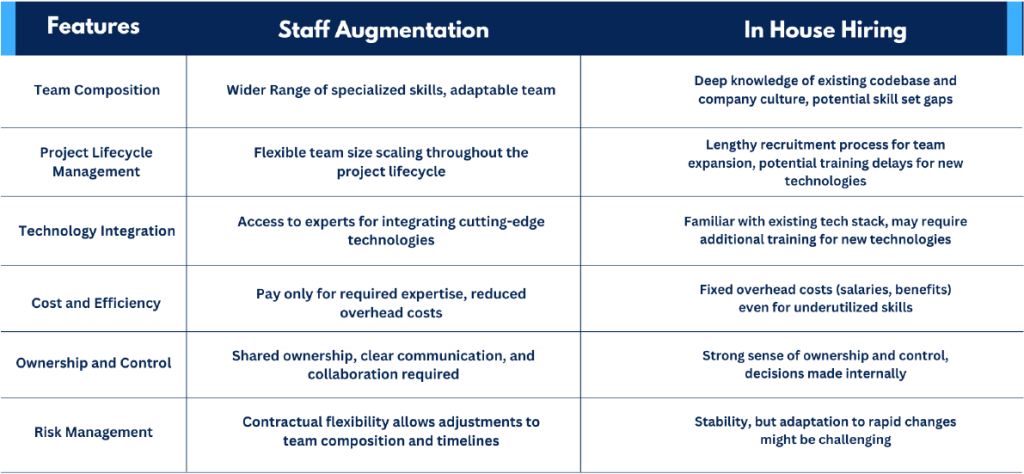
The choice between recruiting software workers internally and through staff augmentation is complex and dependent on several variables, including the project’s demands, available funds, and long-term strategic goals. Although each strategy has advantages, software staff augmentation provides unmatched flexibility, cost-effectiveness, and access to specialist personnel.
Case Study: Recruiting Thingworx and Windchill Candidates for the Department of Defense:
iQuasar offers excellent software staff augmentation services customized to meet your requirements. We provide software experts specializing in all major front-end and back-end technologies, programming languages, frameworks, and platforms. Make the best decision for your software projects to realize your business’s full potential. Contact us today to learn more about how our flexible “pay as you grow” engagement models can help you take your software projects up a notch.