
In 2026, the gap between enterprise ambition and technical reality is wider than ever. While boards demand AI-driven agility and real-time responsiveness, many IT leaders are tethered to monolithic legacy platforms that consume up to 80% of IT budgets just to stay operational. Legacy integration and Pain Points Legacy Systems Integration are no longer a technical hurdle; it is a strategic bottleneck.
To stay competitive, leaders must shift from a “rip-and-replace” mindset to a composable integration strategy. Here is how forward-thinking organizations are tackling the most critical IT decision-maker pain points in legacy modernization today.
1. The Innovation Tax: High Maintenance vs. Zero Growth
The highest cost is opportunity cost. When the majority of your budget is locked into keeping systems running, nothing remains for high-value initiatives like AI implementation or predictive analytics.
The Solution: Incremental Modernization via the Strangler Fig Pattern
Instead of a high-risk “big bang” overhaul, modern leaders wrap legacy cores in a Service Mesh or Anti-Corruption Layer (ACL). This routes new requests to cloud-native services while the legacy core continues handling stable, low-change processes, shifting budget from maintenance to modular growth without risking system-wide outages.
2. The Data Silo Paradox: Fragmented Intelligence
Legacy systems were built for stability, not for the streaming data demands of 2026. Data trapped in proprietary formats or siloed databases blocks the Single Source of Truth required for effective AI and machine learning.
The Solution: Unified Data Lakehouses
A Lakehouse architecture bridges structured legacy data with unstructured modern data.
Action: Deploy Change Data Capture (CDC) to stream legacy updates into a central lakehouse in real time so AI models train on current reality, not yesterday’s batch reports.
3. The Security Vacuum: Legacy Exposure in a Zero Trust World
Most legacy systems rely on perimeter security — the assumption that inside the network means safe. In an era of sophisticated threats and strict compliance frameworks (GDPR, HIPAA), that assumption is a liability.
The Solution: Identity-Aware Integration Layers
Treat every integration point as a potential external threat.
- Zero Trust Enforcement: Deploy API Gateways with MFA and least-privilege access for every legacy system call.
- Policy-as-Code: Automate compliance checks within integration pipelines so legacy data movement never violates regional privacy laws.
4. The Talent Chasm: A Shrinking Pool of Legacy Expertise
The COBOL generation is retiring. Modern engineers have little interest in outdated stacks, creating a critical operational risk: systems no one knows how to fix.
The Solution: Platform Engineering & Low-Code Gateways
Abstract legacy complexity away from your development teams.
- Standardize with APIs: Convert legacy functions into REST or gRPC APIs.
- Empower with Low-Code: Use iPaaS tools so mid-level developers can build workflows on top of legacy data without writing a single line of legacy code.
5. The API-First Mandate
Allowing one-off custom integrations — “spaghetti code” — to solve immediate problems only deepens technical debt over time.
The Strategy: Enforce a strict API-First policy. No application connects to a legacy database directly; every connection routes through a managed API layer.
The Benefit: This creates a buffer zone. When the legacy backend is eventually replaced, front-end applications remain unaffected because the API contract stays intact.
6. Semantic Data Mapping
Legacy systems often use cryptic column names (e.g., DB_USR_01) that modern BI tools cannot interpret, causing delays when extracting business insights.
The Strategy: Implement a Semantic Layer between legacy systems and analytics tools.
The Benefit: It translates legacy jargon into business language — DB_USR_01 becomes Customer_Lifetime_Value — enabling self-service analytics without routing every request through IT.
7. Data Virtualization Over Migration
Moving petabytes of legacy data into the cloud is often too expensive or operationally risky.
The Strategy: Use Data Virtualization software to create a virtual view of legacy data. The data remains in place, but the virtualization layer presents it as a unified, modern cloud database.
The Benefit: All the advantages of centralized access — without the cost or risk of physical data migration.
8. The Golden Record Architecture (MDM)
Legacy systems frequently contain conflicting data — the CRM lists a customer in New York, while billing records list them in London.
The Strategy: Deploy a Master Data Management (MDM) solution as a real-time referee between systems.
The Benefit: When a legacy system surfaces dirty data, MDM cleans it against pre-defined rules before it reaches modern applications — eliminating downstream errors.
Executive Summary: The 2026 Integration Roadmap
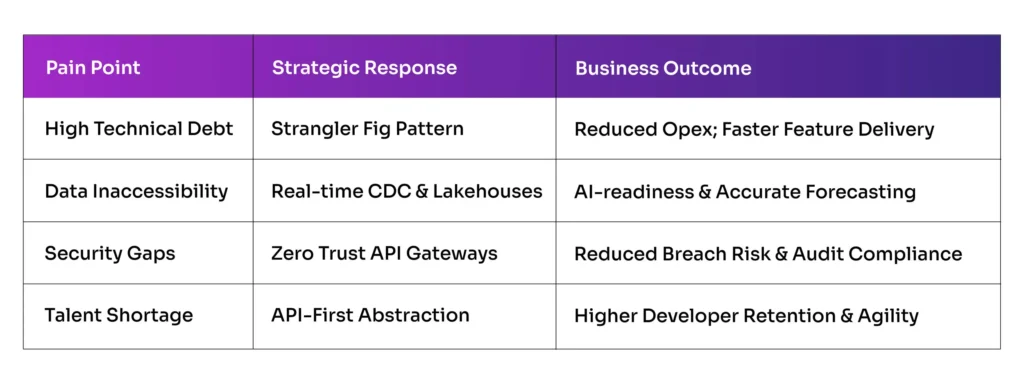
The Bottom Line
Legacy systems should never be the reason digital transformation fails. By treating integration as a modular, ongoing evolution rather than a one-time event, IT leaders can convert these anchors into a stable foundation for the next decade of innovation.
“Modernization is not a project; it is an operating model. The goal is not to eliminate the old, but to ensure it never stops the new.”
Key Takeaways
- Modernizing legacy systems requires a disciplined architectural approach guided by standards such as ISO 42010 and data governance frameworks such as the DAMA-DMBOK.
- An API-first, cloud-native playbook — reinforced by event-driven patterns — decouples legacy cores and accelerates delivery without sacrificing stability.
- A phased roadmap with integrated DevOps/CI-CD and MLOps delivers measurable outcomes: faster time-to-value, improved data quality, and scalable AI capabilities.
- Security and governance are integral to every phase of modernization, aligned with the NIST Cybersecurity Framework — never an afterthought.
- A delivery-focused engineering partner like iQuasar Software translates strategy into concrete, auditable results that move your business forward.
Conclusion
Addressing the IT Decision-Makers’ Pain Points for Legacy Systems Integration remains the defining frontier of enterprise modernization — requiring architecture-led thinking, disciplined governance, and pragmatic delivery. By pairing API-first design, cloud-native patterns, and responsible AI with clear business outcomes, organizations achieve faster time-to-market, lower operating costs, and scalable capabilities.
To explore how iQuasar Software can accelerate your legacy modernization journey, visit iQuasar Software or get in touch to discuss your scenario.
Don’t let legacy infrastructure limit your competitive edge. At iQuasar, our engineering specialists translate complex integration strategies into executable, measurable outcomes — from API-first architecture design to full-scale cloud-native delivery. Ready to move forward? → Explore iQuasar’s Legacy Integration Services